Macro Calculator
“Macros” are the three nutrients that give your food its calories: protein, carbohydrates and fat. Counting them instead of only counting calories helps you eat enough protein to hold on to muscle while you lose fat, and still leave room for the carbs and fat that make meals satisfying.
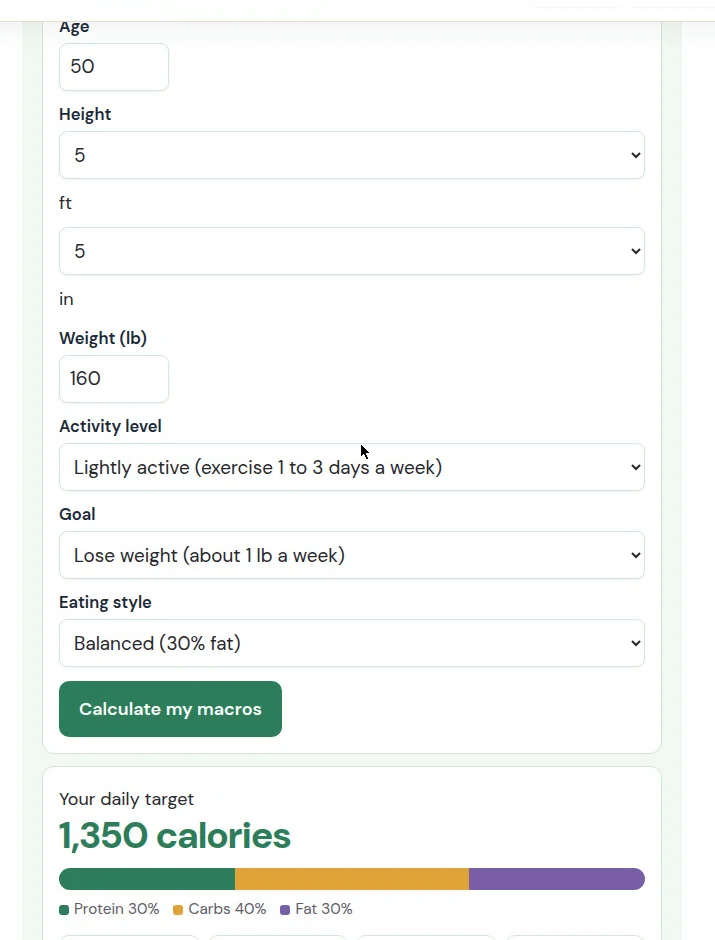
This free macro calculator works for men and women. Enter your age, height, weight, activity and goal, and it works out your daily calories, then splits them into grams of protein, carbs and fat. No sign-up, and nothing you enter is saved. If you’re over 40, you’ll find extra protein guidance further down the page — your needs shift a bit with age, and the section on macros after 40 explains why.
For targets made for menopause, see our menopause calorie calculator.
Macro Calculator
Find your daily calories plus grams of protein, carbs and fat for your goal.
Calories use the Mifflin-St Jeor equation. Protein is set at 1.2 to 1.4 grams per kilogram of body weight.
Quick answer: Macros are protein, carbs and fat — the three nutrients that supply your calories. This calculator turns your daily calories into a gram target for each one. A balanced split is a solid place to start, and when you’re losing weight, hitting your protein target matters most.
How the Macro Calculator Works
- Calories. It estimates the calories you burn each day with the Mifflin-St Jeor equation, then multiplies by your activity level. For weight loss it takes away 250 or 500 calories a day, but never goes below about 1,200 calories.
- Protein first. Protein is set at 1.2 grams per kilogram of body weight to maintain, or 1.4 g/kg while losing weight. Experts on aging suggest at least 1.0 to 1.2 g/kg for older adults, and more for active people, to help keep muscle. For women with a BMI over 30, protein is based on an adjusted weight so the target stays realistic.
- Fat. Fat is set by your eating style: 25%, 30% or 35% of calories, within the 20% to 35% range in the Dietary Guidelines.
- Carbs. Carbohydrates fill the remaining calories.
Example Macros for Women Over 40
For a 45-year-old woman, 5’4″, lightly active, balanced eating style:
| Weight | Goal | Calories | Protein | Carbs | Fat |
|---|---|---|---|---|---|
| 130 lb | Maintain | 1,680 | 71 g | 223 g | 56 g |
| 130 lb | Lose 1 lb a week | 1,200* | 83 g | 127 g | 40 g |
| 150 lb | Maintain | 1,800 | 82 g | 233 g | 60 g |
| 150 lb | Lose 1 lb a week | 1,300 | 95 g | 132 g | 43 g |
| 170 lb | Maintain | 1,930 | 93 g | 245 g | 64 g |
| 170 lb | Lose 1 lb a week | 1,430 | 108 g | 142 g | 48 g |
*Set at the 1,200-calorie floor. For smaller women, a slower pace or more activity is usually a better choice than eating less.
Macros for Weight Loss: What Matters Most
- Calories still count most for weight loss. Macros help you feel full and keep muscle while you eat less.
- Protein is the macro to hit. It keeps you full and helps protect muscle. Spread it out: about 25 to 35 grams at each meal works better than one big serving at dinner.
- Carbs aren’t the enemy. Choose fiber-rich carbs like beans, oats, fruit, vegetables and whole grains. Aim for at least 25 grams of fiber a day.
- Fat keeps meals satisfying. Focus on olive oil, nuts, seeds, avocado and fish.
Best Macro Ratio for Women Over 40
There’s no single best ratio. The U.S. Dietary Reference Intakes give healthy ranges for adults:
| Macro | Healthy range (% of calories) |
|---|---|
| Protein | 10% to 35% |
| Carbohydrates | 45% to 65% |
| Fat | 20% to 35% |
When you’re losing weight, higher protein (around 25% to 30%) often makes it easier to keep muscle and stay full. A lower-carb style can also work if it suits you, but the best plan is the one you can stick to. Don’t forget fiber: check your daily target with our fiber calculator.
Why Macros Change After 40 and Menopause
- Muscle loss speeds up. Women naturally lose muscle with age, and it speeds up around menopause. Less muscle means you burn fewer calories.
- More fat around the middle. Falling estrogen shifts where fat is stored. Enough protein plus strength training helps.
- Bones need support. Protein, calcium, vitamin D and weight-bearing exercise all help. Read more about protecting your bones after 40.
How to Hit Your Macros Without Stress
- Build each meal around a palm-sized portion of protein (chicken, fish, eggs, Greek yogurt, tofu, beans).
- Fill half your plate with vegetables.
- Add a fist of carbs and a thumb of fat.
- Track for 1 to 2 weeks in a free app to learn portions, then go by feel.
Macronutrients in Common Foods
Here’s what the macros look like in foods you probably already eat. The numbers are for one standard serving — a medium piece of fruit, a cup of something cooked, or a palm-sized piece of meat — so you can see at a glance which foods pull their weight for protein and which ones are mostly carbs or fat.
| Food | Serving | Protein | Carbs | Fat |
|---|---|---|---|---|
| Apple | 1 medium | 1 | 25 | 0 |
| Banana | 1 medium | 1 | 27 | 0 |
| Orange | 1 medium | 1 | 15 | 0 |
| Grapes | 1 cup | 1 | 27 | 0 |
| Broccoli | 1 cup cooked | 4 | 11 | 1 |
| Carrots | 1 cup raw | 1 | 12 | 0 |
| Egg | 1 large | 6 | 0 | 5 |
| Chicken breast, cooked | 100 g | 31 | 0 | 4 |
| Beef, cooked | 100 g (lean) | 26 | 0 | 10 |
| Tofu | 100 g | 8 | 2 | 5 |
| Salmon, cooked | 100 g | 25 | 0 | 12 |
| Shrimp, cooked | 100 g | 24 | 0 | 1 |
| White bread | 1 slice | 2 | 12 | 1 |
| Cooked rice | 1 cup | 4 | 45 | 0 |
| Potato | 1 medium baked | 4 | 37 | 0 |
| Butter | 1 tbsp | 0 | 0 | 12 |
| Cheddar cheese | 28 g (1 oz) | 7 | 0 | 9 |
| Whole milk | 1 cup | 8 | 12 | 8 |
| Low-fat yogurt | 170 g | 6 | 8 | 3 |
| Peanut butter | 2 tbsp | 7 | 6 | 16 |
| Almonds | 28 g (1 oz) | 6 | 6 | 14 |
| Oats | 40 g dry | 5 | 27 | 3 |
| Pizza slice, cheese | 1 slice | 12 | 36 | 10 |
| Dark chocolate | 28 g (1 oz) | 2 | 13 | 12 |
| Avocado | 1/2 medium | 1 | 6 | 15 |
Frequently Asked Questions
How many macros should a woman eat to lose weight?
It depends on your size and activity. Many women over 40 do well with about 1.2 to 1.6 grams of protein per kilogram of body weight, 25% to 35% of calories from fat, and the rest from carbs. Use the calculator above for your numbers.
How much protein do women over 40 need?
Often more than the basic 0.8 g/kg guideline. Research groups on aging suggest about 1.0 to 1.2 g/kg, or more if you’re active or losing weight. Find your exact target with our protein calculator.
Do I need to hit my macros exactly?
No. Getting within about 10 grams of protein and 5 to 10% of your calories is plenty. Consistency over weeks matters more than perfect days.
Is a macro diet safe for everyone?
Most healthy adults can use these targets. If you have kidney disease, diabetes, or another health condition, check with your doctor or a dietitian first, because some people need less protein.
How do I calculate my macros?
Work out your daily calories first, then split them into grams. Protein is usually 1.2 to 1.4 grams per kilogram of body weight, fat is 20% to 35% of calories, and carbs fill whatever is left. The calculator above does the maths for you — just enter your age, height, weight, activity and goal.
What is a good macro split for weight loss?
A balanced split is a solid default: about 30% of calories from protein, 45% from carbs and 25% from fat, which sits inside the healthy ranges above. When you’re losing weight, the protein share matters more than the exact split — it keeps you full and protects muscle while the calories do the work.
Related Tools
- Calorie Calculator for Women Over 40
- Protein Calculator for Women Over 40
- Weight Loss Timeline Calculator
- BMI Calculator for Women
- All free tools
This calculator is for general information only and is not medical advice. Talk to your doctor or a registered dietitian before changing your diet if you have a health condition. Read our Medical Disclaimer and Editorial Policy.
Sources
- Mifflin MD, St Jeor ST, et al. A new predictive equation for resting energy expenditure in healthy individuals. Am J Clin Nutr. 1990 — https://pubmed.ncbi.nlm.nih.gov/2305711/
- Bauer J, et al. Evidence-based recommendations for optimal dietary protein intake in older people: a position paper from the PROT-AGE Study Group. J Am Med Dir Assoc. 2013 — https://researchexperts.utmb.edu/en/publications/evidence-based-recommendations-for-optimal-dietary-protein-intake/
- National Academies: Dietary Reference Intakes for Energy, Carbohydrate, Fiber, Fat, Fatty Acids, Cholesterol, Protein, and Amino Acids — https://www.nationalacademies.org/read/10490/chapter/4
- Lovejoy JC, et al. Increased visceral fat and decreased energy expenditure during the menopausal transition. Int J Obes. 2008 — https://pubmed.ncbi.nlm.nih.gov/18332882/
- Dietary Guidelines for Americans — https://www.dietaryguidelines.gov/