Protein Calculator for Women Over 40
Use this protein calculator for women to estimate your daily protein needs from your weight, activity level, and goal — as an honest range with a practical starting point and your approximate protein per meal.
Find your protein target
Your everyday inputs — takes less than a minute. No account needed.
Your estimated protein target
A note on GLP-1 medications
GLP-1 medications can reduce appetite, which may make it harder to meet protein needs during weight loss. Your estimate above does not replace individualized nutrition advice. Focus on adequate protein, regular meals, and resistance exercise where appropriate.
This checkbox did not change your calculation — there is no automatic protein multiplier for GLP-1 use, because the evidence does not support one as a blanket rule.
Please follow your clinician's guidance
This calculator can't give you a personalized number. Kidney disease, pregnancy, breastfeeding, and some medications change protein needs in ways a general tool cannot account for — for example, advanced kidney disease may require restricting protein rather than increasing it.
Talk to your doctor, nurse, pharmacist, or a registered dietitian about the right daily protein target for you.
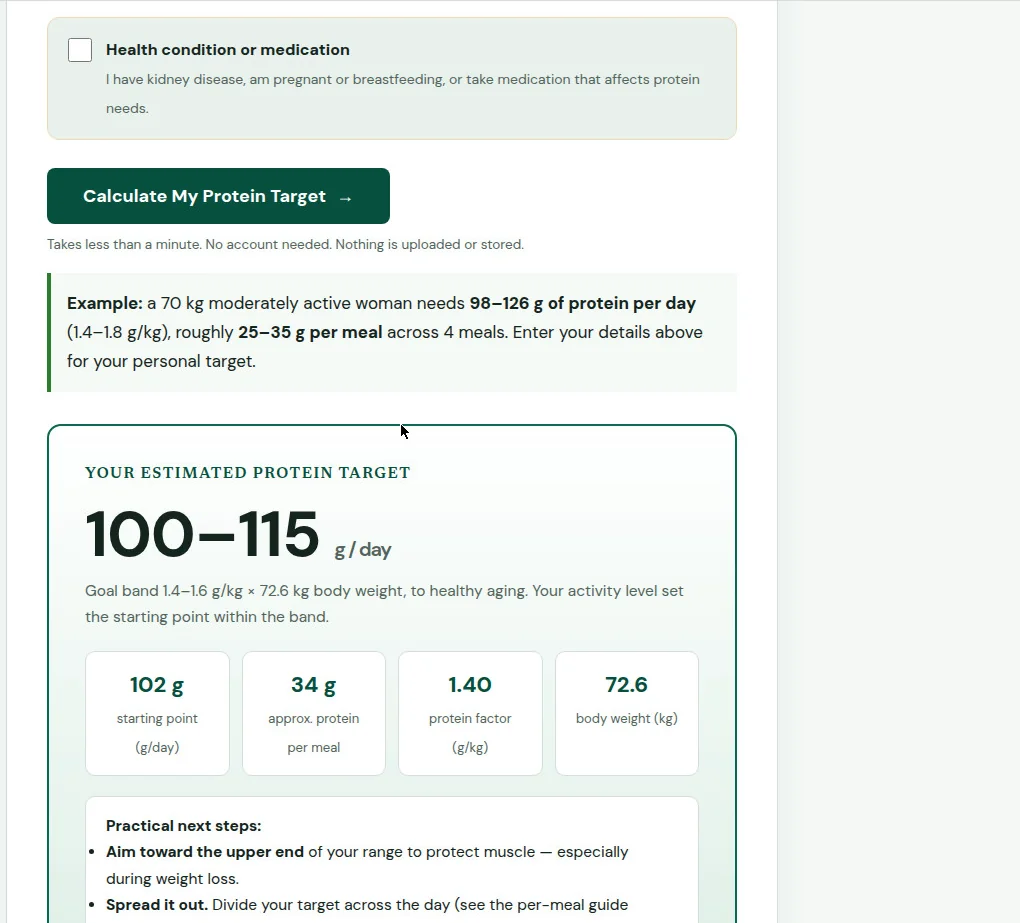
How to read your protein calculator result
Your result is an estimated range with a practical starting point — not an exact requirement. Body composition, training history, health conditions, and daily activity all shift real needs, so a range is more honest than a precise-looking number.
- Start near the starting point (~120 g/day style) on an ordinary week, then adjust by how you feel, train, and recover.
- Training hard or dieting? Aim toward the upper end of your range to protect muscle.
- Spread it out. Divide your target across the day (see the per-meal guide below) rather than loading it into one meal.
- Re-check when life changes — new training block, weight change, or a new medication can all move your target.
- This is a planning estimate, not a medical prescription. If a clinician manages your nutrition, their plan wins.
How Much Protein Do You Need to Lose Weight?
If your goal is weight loss, choose "Lose weight" in the calculator above. When you eat fewer calories, getting enough protein matters even more, because it helps you keep muscle while you lose fat and helps you feel full.
Research on weight loss commonly uses about 1.2 to 1.6 grams of protein per kilogram of body weight a day (about 0.55 to 0.7 grams per pound). That's higher than the basic RDA of 0.8 g/kg, which is set to prevent deficiency, not to protect muscle during weight loss.
| Your weight | Protein per day for weight loss (approx.) |
|---|---|
| 130 lb | 71 to 94 g |
| 150 lb | 82 to 109 g |
| 170 lb | 93 to 123 g |
| 190 lb | 103 to 138 g |
| 210 lb | 114 to 152 g |
- Spread protein across your meals, aiming for about 25 to 35 g per meal.
- Pair protein with strength training 2 or more days a week to protect muscle.
- Choose lean sources: eggs, Greek yogurt, fish, chicken, beans, lentils, tofu.
- If you have kidney disease, talk to your doctor before increasing protein.
Want the full picture? Find your calorie target with our calorie calculator for women and check your BMI.
Why protein matters more after 40
Three things change in midlife, and they all point the same way:
- Muscle mass naturally declines with age — and the menopause transition can accelerate shifts in body composition. Protein plus resistance exercise is the best-supported defense.
- Appetite and intake often drop. CSIRO's 2026 analysis reported that women aged 40–55 fall about 35 g short of 1.2 g/kg/day, with only one in three meeting that level — an Australian finding, but the pattern (under-eating protein in midlife) is widely recognized.
- The old RDA wasn't built for this. The 0.8 g/kg/day RDA is a minimum to avoid deficiency in mostly sedentary adults — not an optimal target for preserving strength after 40.
Practical takeaway: most women over 40 do better aiming for the upper part of the general range (around 1.4–1.6 g/kg/day), distributing protein across meals, and pairing it with strength training twice a week or more.
Your protein per meal, made practical
This calculator doesn't stop at a daily number — it splits your starting target across your meals into an approximate protein-per-meal guide. Total daily intake matters most, but spreading protein through the day supports muscle maintenance better than loading it all into dinner. Nutrition reviews have proposed roughly 0.3–0.4 g/kg per meal as a useful guide — there is no universal per-meal absorption limit.
What that looks like on a plate (approximate protein):
- ≈ 30 gChicken breast, cooked (100 g)
- ≈ 25 gSalmon fillet, cooked (100 g)
- ≈ 18 gLentils, cooked (1 cup)
- about 15 to 20 gGreek yogurt, 1 cup (plain)
- ≈ 12 gTwo large eggs
- ≈ 11 gCottage cheese (100 g)
Protein in common foods
Use this reference table to turn your daily target into actual meals. Values are approximate averages from USDA FoodData Central — brands, cuts, and cooking methods shift them slightly.
| Food | Serving | Protein (approx) |
|---|---|---|
| Chicken breast, cooked | 100 g (3.5 oz) | 31 g |
| Turkey breast, cooked | 100 g (3.5 oz) | 30 g |
| Pork loin, cooked | 100 g (3.5 oz) | 27 g |
| Lean beef (90%), cooked | 100 g (3.5 oz) | 26 g |
| Tuna, canned in water, drained | 100 g (3.5 oz) | 26 g |
| Salmon, cooked | 100 g (3.5 oz) | 25 g |
| Shrimp, cooked | 100 g (3.5 oz) | 24 g |
| Lentils, cooked | 1 cup (198 g) | 18 g |
| Greek yogurt, 1 cup (plain) | 1 cup | about 15 to 20 g |
| Edamame, shelled | 1 cup (155 g) | 17 g |
| Chickpeas, cooked | 1 cup (164 g) | 15 g |
| Black beans, cooked | 1 cup (172 g) | 15 g |
| Eggs | 2 large | 12 g |
| Cottage cheese, low-fat | 100 g (3.5 oz) | 11 g |
| Tofu, firm | 100 g (3.5 oz) | 10 g |
| Milk | 1 cup (240 ml) | 8 g |
| Quinoa, cooked | 1 cup (185 g) | 8 g |
| Peanut butter | 2 tbsp (32 g) | 8 g |
| Cheddar cheese | 30 g (1 oz) | 7 g |
| Almonds | 30 g (1 oz, ~23 nuts) | 6 g |
Tip: build each meal around one protein anchor from this table first — a palm-to-two-palms-sized portion — then add vegetables, whole grains, and healthy fats around it.
Protein RDA by life stage
The Recommended Dietary Allowance (RDA) is the minimum daily intake considered adequate for most healthy people — a floor to avoid deficiency, not an optimal target for preserving muscle after 40. This calculator's evidence-based bands (1.4–2.0 g/kg/day) deliberately sit above it:
| Life stage | RDA | Notes |
|---|---|---|
| Adults 19+ | 0.8 g/kg/day | Minimum to avoid deficiency in mostly sedentary adults |
| Pregnancy | 1.1 g/kg/day | Higher needs to support fetal growth |
| Lactation | 1.3 g/kg/day | Higher needs to support milk production |
| Adults 65+ (PROT-AGE suggestion) | ≥ 1.0–1.2 g/kg/day | Suggested minimum for older adults; 1.2–1.5 with acute or chronic disease |
Sources: National Academies, Dietary Reference Intakes for Energy, Carbohydrate, Fiber, Fat, Fatty Acids, Cholesterol, Protein, and Amino Acids (2005); Bauer et al., PROT-AGE Study Group (2013). If a clinician manages your nutrition, their target overrides any reference value.
GLP-1 medications and protein
GLP-1 medications (such as semaglutide and tirzepatide) are effective for weight loss — but appetite suppression can make protein the first thing to slip. A 2026 systematic review of 20 trials found that roughly a quarter to a third of incretin-related weight loss was lean mass, and the groups combining treatment with resistance training kept the most favorable body-composition profile.
- Prioritize protein at every meal — small appetites need protein-dense foods first, not last.
- Keep resistance exercise — it was the single biggest differentiator for preserving muscle during treatment.
- Eat on a schedule rather than waiting for hunger cues that may not come.
This calculator deliberately does not auto-raise your target for GLP-1 use — the evidence doesn't support a blanket multiplier. The optional GLP-1 question only adjusts the guidance shown with your result. Discuss your individual target with your clinician.
When this calculator isn't for you
This is a general-education tool. It cannot account for conditions that change protein needs:
- Kidney disease: advanced kidney disease may require restricting protein — more is not better here.
- Pregnancy and breastfeeding have their own protein reference values.
- Medications and other conditions (liver disease, metabolic disorders, recovery from surgery) need individualized targets.
If any of these apply, tick the health-condition box in the calculator — it will point you to clinical guidance instead of a number. Your clinician's or dietitian's plan always overrides this tool.
Common questions, answered directly
Why do protein needs rise after 40?
Muscle becomes less responsive to protein as you age (anabolic resistance), and midlife hormonal shifts accelerate body-composition changes. Slightly higher intakes plus resistance training counter both — which is why the evidence-based range for active adults sits well above the basic RDA.
Is the RDA of 0.8 g/kg enough?
It's the minimum to avoid deficiency in mostly sedentary adults — not an optimal target for preserving muscle and strength after 40. Research reviews for active and older adults consistently land higher, around 1.2–1.6 g/kg/day and up depending on activity.
Can I hit my target without protein powder?
Usually, yes. Three protein-centered meals built on eggs, dairy, fish, poultry, legumes, or tofu get most women to 100–130 g/day. Powders are a convenience tool for gaps — not a requirement.
Does protein timing matter more than the daily total?
No — total daily intake is the main driver. Timing and distribution are refinements: spreading protein across 3–4 meals supports muscle maintenance better than one giant dinner, but no single "anabolic window" makes or breaks your results.
How this protein calculator works: methodology & evidence
This tool states every assumption. Nothing is a black box:
- Body weight: pounds are converted to kilograms (÷ 2.20462). Your goal then selects a protein factor band — the single biggest driver of your estimate.
- Factor bands (frozen):
Your goal Protein factor band General healthy aging (maintain weight / healthy aging) 1.4–1.6 g/kg/day Weight loss / muscle preservation 1.6–1.8 g/kg/day Strength training / muscle-focused 1.8–2.0 g/kg/day - Activity: your activity level positions the starting point within your goal's band (sedentary → lower end, very active → upper end). The 2.0 ceiling is reachable only with a strength-training goal and very-high activity — it is not presented as better for everyone.
- Result: an estimated range (band × your weight, rounded to 5 g) plus a starting point — because body composition and training history make false precision dishonest.
- Per-meal split: starting point ÷ your meals per day, labeled approximate. No universal absorption threshold is claimed.
Why isn't PROT-AGE used to justify the 2.0 ceiling?
PROT-AGE is a respected recommendation — but for adults over 65, with a baseline of at least 1.0–1.2 g/kg/day (1.2–1.5 with acute or chronic disease). Stretching it to justify 2.0 g/kg for every woman over 40 would misrepresent it. Our 2.0 ceiling rests instead on the ISSN position stand (1.4–2.0 g/kg/day sufficient for most exercising individuals) and the resistance-training meta-analysis showing benefits up to ~1.62 g/kg/day — and it stays gated to very active, strength-focused users.
Why no automatic GLP-1 multiplier?
It would be a convenient shortcut — but no trial evidence supports a blanket "+0.2 g/kg for GLP-1 users" rule. The 2026 nutrition review proposes ≥1.2 g/kg/day (up to 1.6 for appropriate adults without kidney disease) as clinical guidance, not a calculator multiplier. So the GLP-1 input changes only the guidance text, honestly.
Sources: [1] Jäger et al., International Society of Sports Nutrition position stand: protein and exercise, J Int Soc Sports Nutr, 2017 — PubMed 28642676 · [2] Morton et al., A systematic review, meta-analysis and meta-regression of the effect of protein supplementation on resistance training-induced gains in muscle mass and strength in healthy adults, Br J Sports Med, 2018 — PubMed 28698222 · [3] Bauer et al., PROT-AGE Study Group, Evidence-based recommendations for optimal dietary protein intake in older people, J Am Med Dir Assoc, 2013 — PubMed 23867520 · [4] Changes in lean mass with incretin-based therapies: systematic review and meta-analysis, Diabetes Obes Metab, 2026 — PubMed 41877354 · [5] Medical nutrition therapy in the GLP-1 era, Clin Nutr ESPEN, 2026 — PubMed 42036071 · [6] CSIRO, The protein gap: importance of protein during menopause, news release, 1 Sept 2026 — csiro.au
Related reading
Protein doesn't work alone — muscle, hormones, and midlife weight changes are all connected:
Related tools
Protein calculator FAQs
Short answers to the questions readers ask most. (The everyday questions — RDA, powders, timing — are answered in the section above.)
It depends on body weight, activity level, and goal. Evidence supports roughly 1.2–2.0 grams of protein per kilogram of body weight per day for active adults, with 1.4–1.6 g/kg/day a reasonable starting range for general healthy aging. For example, a 70 kg (154 lb) moderately active woman would land around 98–112 g per day. This calculator gives you a personalized estimated range rather than a single number.
The US RDA of 0.8 g/kg/day is a minimum to avoid deficiency, not an optimal target for preserving muscle. For women over 40, evidence-supported ranges are about 1.4–1.6 g/kg/day for general healthy aging, 1.6–1.8 g/kg/day when losing weight while preserving muscle, and up to 1.8–2.0 g/kg/day for strength-training-focused, highly active women (per the International Society of Sports Nutrition position stand).
A practical approach is to divide your daily target across your meals — for example, about 25–35 g per meal across three meals, or adjusted for how many meals you eat. Nutrition reviews have proposed roughly 0.3–0.4 g/kg per meal as a useful guide. There is no universal per-meal absorption limit; total daily intake matters most, and spreading protein through the day supports muscle maintenance.
Midlife is when protein deserves extra attention: CSIRO's 2026 analysis found that women aged 40–55 fall about 35 g short of 1.2 g/kg/day, with only one in three meeting that level. Muscle mass naturally declines with age, and the menopause transition can accelerate changes in body composition. Aim for the upper part of the general range (around 1.4–1.6 g/kg/day), distribute protein across meals, and combine it with resistance exercise.
For healthy, highly active adults focused on strength training, up to 2.0 g/kg/day sits within the range the International Society of Sports Nutrition considers sufficient (1.4–2.0 g/kg/day). However, a large meta-analysis found no additional muscle-mass benefit beyond about 1.6 g/kg/day from protein supplementation during resistance training — so 2.0 is a ceiling for very active users, not a goal for everyone. If you have kidney disease, follow your clinician's guidance instead.
GLP-1 medications can reduce appetite, which may make it harder to meet protein needs while losing weight — and research shows roughly a quarter to a third of incretin-related weight loss can be lean mass. Nutrition reviews suggest at least 1.2 g/kg/day with protein spread across meals, plus resistance training, for adults without kidney disease. This calculator does not automatically raise your target for GLP-1 use; discuss your individual needs with your clinician.
Per typical serving, the highest-protein everyday foods are cooked chicken or turkey breast (about 30 g per 100 g), canned tuna (about 26 g per 100 g), salmon (about 25 g per 100 g), and lean beef (about 26 g per 100 g). Strong plant options include lentils (about 18 g per cup), edamame (about 17 g per cup), and chickpeas or black beans (about 15 g per cup). See the full protein-in-foods reference table above for 20 foods with serving sizes.
The US RDA is 0.8 g per kilogram of body weight per day for adults 19 and over — 1.1 g/kg/day during pregnancy and 1.3 g/kg/day during lactation. It is a minimum to avoid deficiency, not an optimal target: for women over 40 aiming to preserve muscle, evidence-supported ranges sit higher, around 1.4–1.6 g/kg/day for general healthy aging. See the RDA reference table above.