What Are the 34 Symptoms of Perimenopause? The Full Checklist, Explained
Quick answer: The “34 symptoms of perimenopause” is a popular checklist that circulates online. It is not an official medical list. Medical sources such as Mayo Clinic and the NHS describe a range of symptoms, led by irregular periods, hot flashes, night sweats, sleep problems and mood changes. Some items on the list are well supported by research, others are commonly reported but less studied. No one gets all 34, and many of these symptoms have other causes too.
Try it yourself: Not sure whether your symptoms add up to perimenopause? Our free perimenopause quiz asks 12 quick questions about your cycle and common symptoms, then gives you a printable summary to take to your doctor.
The 34 Symptoms of Perimenopause Checklist
Here is the full list as it usually appears online, grouped by type. The last column tells you honestly how strong the link to perimenopause is.
| Symptom | What it can feel like | How common / evidence note |
|---|---|---|
| Cycle changes | ||
| 1. Irregular periods | Cycles get shorter or longer, heavier or lighter, or skip months | Very common and usually the earliest sign; a core part of how perimenopause is defined |
| 2. Breast pain or tenderness | Sore, swollen or sensitive breasts | Commonly reported; linked to fluctuating hormones, but also has many non-hormonal causes |
| Temperature (vasomotor) | ||
| 3. Hot flashes | A sudden wave of heat over the face, neck and chest, sometimes with flushing | Among the most common symptoms; well documented |
| 4. Night sweats | Hot flashes during sleep, waking damp or soaked | Very common; well documented |
| 5. Irregular heartbeat (palpitations) | A racing, pounding or fluttering heart, sometimes during a hot flash | Listed by the NHS as a menopause symptom; new palpitations should still be checked |
| Sleep and energy | ||
| 6. Sleep problems | Trouble staying asleep, waking at 2 to 4 AM | Very common; Mayo Clinic lists sleep problems as a key symptom |
| 7. Fatigue | Feeling drained even after a full night in bed | Commonly reported; often tied to broken sleep |
| Mood and brain | ||
| 8. Mood swings | Feeling fine one hour, tearful or snappy the next | Common; well documented |
| 9. Irritability | A shorter fuse than usual | Common; well documented |
| 10. Anxiety | New worry, tension or a sense of dread | Common; listed by the NHS |
| 11. Depression | Persistent low mood, loss of interest | Risk of depression rises during the transition; needs proper assessment |
| 12. Panic attacks | Sudden fear with racing heart and breathlessness | Commonly reported; research is limited |
| 13. Difficulty concentrating | Struggling to focus or follow conversations | Common; often called brain fog |
| 14. Memory lapses | Losing words, forgetting why you walked into a room | Common; research suggests it is usually temporary |
| 15. Headaches | New or changing headaches or migraines | Listed by the NHS; some women with hormone-related migraines notice changes |
| Body, skin and hair | ||
| 16. Weight gain | Weight settling around the middle | Common in midlife; aging, muscle loss and hormones all play a part |
| 17. Bloating | A swollen, full belly | Commonly reported; research is limited |
| 18. Digestive problems | Gas, indigestion, changes in bowel habits | Commonly reported; research is limited |
| 19. Joint pain | Stiff, achy joints, often worse in the morning | Listed by the NHS as a common symptom |
| 20. Muscle tension | Tight neck, shoulders or back | Commonly reported; research is limited |
| 21. Hair thinning | A wider part, a thinner ponytail | Common in midlife; hormones are one of several causes |
| 22. Brittle nails | Nails that split or break easily | Commonly reported; research is limited |
| 23. Itchy or dry skin | Dry, itchy or more sensitive skin | Listed by the NHS as a menopause symptom |
| 24. Body odor changes | Sweat smelling different or stronger | Commonly reported; research is limited |
| 25. Gum problems | Sore, bleeding or receding gums | Commonly reported; research is limited, so see a dentist |
| 26. Burning mouth or tongue | A burning or scalded feeling in the mouth | Burning mouth syndrome is more common in women after menopause; research on perimenopause is limited |
| 27. Bone loss (osteoporosis) | Usually no symptoms until a fracture | Bone loss speeds up around menopause (Mayo Clinic); it is a risk, not something you feel |
| Urinary, vaginal and sexual | ||
| 28. Vaginal dryness | Dryness, itching or discomfort, pain during sex | Common and well documented; very treatable |
| 29. Lower sex drive | Less interest in sex | Common; listed by Mayo Clinic and the NHS |
| 30. Urinary incontinence | Leaks when you cough or sneeze, sudden urgency | Common; Mayo Clinic lists bladder problems |
| Other | ||
| 31. Dizziness | Feeling lightheaded or off balance | Commonly reported; research is limited, and it has many other causes |
| 32. Allergies | New or worse allergies | Commonly reported; research is limited |
| 33. Electric shock sensations | A brief zap under the skin, sometimes just before a hot flash | Commonly reported; research is limited |
| 34. Tingling hands or feet | Pins and needles in the extremities | Commonly reported; research is limited, and it is worth checking for other causes such as low vitamin B12 or diabetes |
Grouped by how common they are, the same 34 symptoms look like this:
Very common: irregular periods, hot flashes, night sweats and sleep problems.
Common: breast pain or tenderness, palpitations, fatigue, mood swings, irritability, anxiety, depression, difficulty concentrating, memory lapses, headaches, weight gain, joint pain, hair thinning, itchy or dry skin, vaginal dryness, lower sex drive and urinary incontinence.
Less common, or less studied: panic attacks, bloating, digestive problems, muscle tension, brittle nails, body odor changes, gum problems, burning mouth or tongue, dizziness, allergies, electric shock sensations and tingling hands or feet. Bone loss belongs here in a different way: it speeds up around menopause but has no symptoms you can feel until a fracture.
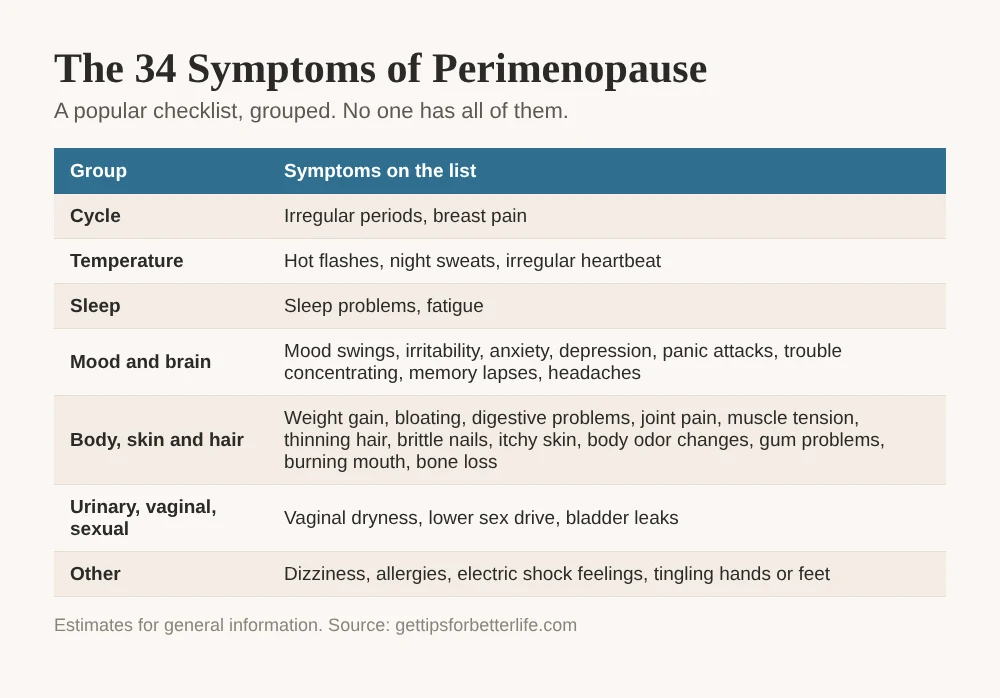
Notice that only some of these are “classic” perimenopause symptoms. Items marked “research is limited” may still be real for you. It simply means studies haven’t clearly shown that perimenopause causes them, so it’s worth ruling out other causes before assuming it’s hormones.
When Does Perimenopause Usually Start?
According to Mayo Clinic, most women notice the first signs, usually cycle changes, sometime in their 40s, though some notice changes as early as their 30s or as late as their 50s. It usually lasts several years, and the length varies a lot from woman to woman.
You reach menopause after 12 months in a row without a period. In the United States, the average age of menopause is about 51 to 52. Menopause before age 40 is called premature menopause, and before 45 is called early menopause. Both are worth discussing with a doctor.
The Stages of Perimenopause: Early vs. Late
Researchers use a staging system called STRAW+10 to describe reproductive aging. You don’t need a blood test to estimate where you are. Your cycle is the main clue, and Mayo Clinic describes it in simple terms:
| Stage | What your cycle looks like |
|---|---|
| Early perimenopause | Cycle length starts varying by 7 days or more from month to month, and this keeps happening |
| Late perimenopause | Gaps of 60 days or more between periods |
| Menopause | 12 months in a row with no period |
Hot flashes and sleep problems often become more noticeable in late perimenopause, but every woman’s pattern is different. Tracking your cycle for a few months is the easiest way to see which stage fits.
Which Symptoms Are Most Common?
Of the 34, the ones with the strongest research behind them are:
- Irregular periods. Usually the first sign. See our guide to early signs of perimenopause in your 40s.
- Hot flashes and night sweats. Among the most common symptoms. In the long-running SWAN study (Study of Women’s Health Across the Nation), women with frequent hot flashes or night sweats had them for a median of 7.4 years in total.
- Sleep problems. Waking in the night is very common, sometimes before hot flashes start. Read why you wake up at 3 AM.
- Mood changes. Irritability, anxiety and low mood are common, and the risk of depression is higher during the transition.
- Brain fog. Word-finding and focus problems are common and, for most women, temporary. See menopause brain fog: causes and what helps.
- Vaginal dryness and bladder changes. These tend to build over time and often continue after menopause, but they respond well to treatment.
Red Flags: When to See a Doctor Promptly
Some changes should not be written off as “just perimenopause.” Contact a doctor promptly if you have:
- Very heavy bleeding
- Periods that last longer than 7 days
- Periods that come closer together than 21 days
- Bleeding between periods or after sex
- Any bleeding after 12 months without a period
- Palpitations with chest pain, dizziness, fainting or shortness of breath. These need urgent care, so call 911. Read more in heart palpitations in menopause: when to worry.
- Persistent low mood, or thoughts of harming yourself. Talk to a doctor soon. If you are in crisis, call or text 988 (the Suicide and Crisis Lifeline) or call 911.
These signs don’t automatically mean something serious, but they deserve a proper check.
Symptoms That Can Look Like Perimenopause
Many of the 34 symptoms overlap with other common, treatable conditions. Ask your doctor about testing for:
| Condition | Overlapping symptoms | How it’s checked |
|---|---|---|
| Thyroid problems | Fatigue, weight change, palpitations, mood changes, irregular periods, hair thinning | Blood test |
| Iron deficiency anemia | Tiredness, dizziness, breathlessness, brittle nails, hair shedding | Blood test |
| Depression or anxiety | Low mood, poor sleep, poor focus, fatigue | Talking with your doctor, sometimes questionnaires |
| Pregnancy | Missed or irregular periods, breast tenderness, fatigue | Pregnancy test. You can still get pregnant in perimenopause |
| Low vitamin B12 or diabetes | Tingling hands or feet, fatigue | Blood tests |
For women over 45, doctors usually diagnose perimenopause from symptoms and cycle changes, not from a single hormone test, because hormone levels rise and fall so much. Blood tests are most useful for ruling out the conditions above.
What Helps With Perimenopause Symptoms
Everyday basics:
- Track your symptoms and cycle for two to three months. It makes your appointment far more useful.
- Protect your sleep with a cool bedroom, a steady wake-up time, and less alcohol and caffeine later in the day.
- Stay active. Regular exercise, including strength training, supports mood, sleep, muscle and bone.
- Eat for midlife. Calorie needs drop with age. Our menopause calorie calculator shows your numbers.
- Notice your hot flash triggers, such as alcohol, spicy food, caffeine or a warm room.
Talk to a clinician about treatment. Hormone therapy is the most effective treatment for hot flashes and night sweats, and for many healthy women within about 10 years of menopause the benefits are considered to outweigh the risks. It isn’t right for everyone. Non-hormonal prescription options and low-dose vaginal estrogen are also available. The right choice depends on your health history.
What about supplements? According to the National Center for Complementary and Integrative Health (NCCIH), there is no strong evidence that most herbal or dietary supplements relieve menopause symptoms, and some can interact with medications. If you’re considering one, check with your doctor or pharmacist first.
For hair changes, see thinning hair in menopause: causes and what helps.
Frequently Asked Questions
What are the 34 symptoms of perimenopause?
It’s a popular online checklist, not an official medical list. It includes irregular periods, hot flashes, night sweats, sleep problems, mood swings, anxiety, brain fog, joint pain, vaginal dryness, weight gain and less-studied items like electric shock sensations and burning mouth. The full list is in the table above.
What are the 40 symptoms of perimenopause?
It’s the same idea as the 34 symptoms list, just a longer version. Different websites split or add a few items, so the total changes. There is no official count. What matters is which symptoms you have and how much they affect you.
What is the minimum age for perimenopause?
There’s no strict minimum. It most often starts in the 40s, and some women notice changes in their 30s. If periods stop before 40, see a doctor, since that’s considered premature menopause and should be checked.
How do I tell which stage of perimenopause I am in?
Look at your cycle. If your cycle length keeps varying by 7 days or more, you’re likely in early perimenopause. If you’re going 60 days or more between periods, you’re likely in late perimenopause. Twelve months with no period means you’ve reached menopause.
What vitamins help with perimenopause?
No vitamin has been proven to treat perimenopause itself. Getting enough calcium and vitamin D supports bone health, which matters more as estrogen falls. Evidence for most supplements marketed for menopause symptoms is limited. Ask your doctor to check iron, B12 and vitamin D if you’re tired or achy.
Can you have perimenopause symptoms with regular periods?
Yes. Some women notice sleep changes, mood shifts or night sweats while their periods are still fairly regular. Changes in cycle length usually follow.
How long do perimenopause symptoms last?
It usually lasts several years, and symptoms vary. In the SWAN study, frequent hot flashes and night sweats lasted a median of 7.4 years in total, sometimes continuing after menopause.
Can I still get pregnant during perimenopause?
Yes. Fertility declines but doesn’t reach zero until you’ve gone 12 months without a period, so use contraception if you don’t want to get pregnant.
Related Tools
This article is for general information only and is not medical advice. Read our Medical Disclaimer.
Sources
- Mayo Clinic: Perimenopause — Symptoms and causes — https://www.mayoclinic.org/diseases-conditions/perimenopause/symptoms-causes/syc-20354666
- Mayo Clinic: Menopause — Symptoms and causes — https://www.mayoclinic.org/diseases-conditions/menopause/symptoms-causes/syc-20353397
- NIA: What Is Menopause? — https://www.nia.nih.gov/health/menopause/what-menopause
- NHS: Menopause symptoms — https://www.nhs.uk/conditions/menopause/symptoms/
- Avis NE, et al. Duration of menopausal vasomotor symptoms over the menopause transition (SWAN). JAMA Intern Med. 2015 — https://pubmed.ncbi.nlm.nih.gov/25686030/
- NCCIH: Menopausal Symptoms and Complementary Health Approaches — https://www.nccih.nih.gov/health/menopausal-symptoms-and-complementary-health-approaches
- The Menopause Society: Menopause FAQs — https://menopause.org/patient-education/menopause-faqs
Keep reading
More evidence-based guides for staying strong after 40.