Why Are My Hands Always Cold? Causes and When to Worry After 40
Quick answer
Cold hands are usually just your body sending blood to your core instead of your fingers — totally normal in a cool room or after a cold drink. But if it’s happening constantly, even indoors, in a warm room, or alongside tiredness, hair thinning, or irregular periods, it’s worth checking for a few specific causes that get more common after 40: an underactive thyroid, low iron, poor circulation, or Raynaud’s phenomenon. Most of these are easy to test for and manageable once you know what’s going on.
A quick self-check — next time your hands feel cold, check three things before you assume the worst:
- Are your feet cold too, or just your hands? Both cold = usually circulation or temperature. Hands only, especially fingertips turning white or blue, = more likely Raynaud’s.
- Is it one hand or both? One-sided coldness that shows up suddenly is the one version of this that needs same-day medical attention — it can point to a blocked blood vessel.
- How do you feel otherwise? Tired, foggy, gaining weight, hair falling out = worth a thyroid panel. Tired, breathless on stairs, pale = worth checking iron/ferritin.
If none of that rings a bell and your hands just run cold the way they always have, you’re probably in the “normal, just how your circulation works” category below.
Why your hands get cold in the first place
Your body is constantly deciding where blood goes, and your hands are low on the priority list. When your core temperature drops even slightly — a cold room, a cold drink, stepping outside — the small blood vessels in your fingers narrow (vasoconstriction) to keep warm blood near your organs. It’s a protective reflex, not a malfunction.
Women’s hands tend to run a little colder than men’s, and hormones play some part in how the small blood vessels in the fingers react to cold. Researchers are still working out exactly how, so we’ll stick to what’s clearer: several of the causes below, like thyroid problems and low iron from heavy periods, become more common in your 40s and 50s.
None of that is dangerous by itself. It becomes worth a closer look when it’s constant, one-sided, or paired with other symptoms — here’s what actually causes that.
7 real causes of cold hands
1. Normal vasoconstriction (the most common one)
This is the reflex from the section above, set off by cold, stress, or even a cold drink. It explains the vast majority of “why are my hands always cold” searches. There is no underlying condition, and no treatment is needed beyond gloves and warm drinks.
2. Raynaud’s phenomenon
Raynaud’s is an exaggerated version of that same reflex: the blood vessels in your fingers (sometimes toes, nose, or ears) spasm shut in response to cold or stress, and the skin visibly changes color — often white, then blue, then red as blood flow returns. It’s genuinely common: estimates put it at roughly 3–5% of adults, and it’s several times more common in women than men.
There are two versions worth knowing apart:
- Primary Raynaud’s shows up earlier in life, usually by your 20s or 30s, isn’t linked to another disease, and tends to stay mild.
- Secondary Raynaud’s tends to show up for the first time after 40, is more often one-sided or asymmetric, and is more likely to be connected to an autoimmune condition (like lupus or scleroderma) or a medication. New Raynaud’s-type symptoms starting after 40 are one of the few things on this list that genuinely deserve a doctor’s visit, mainly to rule out what’s driving it.
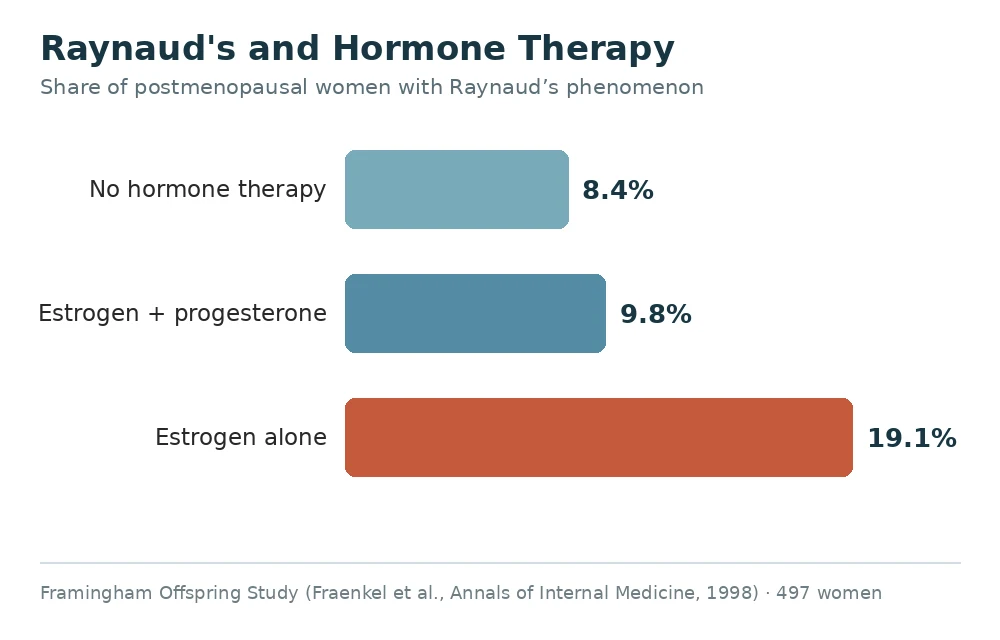
There’s also a hormonal thread here: a long-running Framingham Offspring Study analysis found Raynaud’s was notably more common in postmenopausal women taking estrogen alone (about 19%) than in those on combined estrogen-progesterone therapy (about 10%) or no hormone therapy (about 8%). It was a small study, but it suggests estrogen may affect how these vessels respond to cold. If you’re on hormone therapy and notice Raynaud’s-type symptoms, mention it to your doctor.
3. An underactive thyroid (hypothyroidism)
Your thyroid controls your metabolic rate, and metabolic rate drives how much heat your body generates. When thyroid hormone runs low, your whole system — including circulation to your hands and feet — slows down, and cold hands are one of the classic early signs, usually alongside fatigue, weight gain, dry skin, and hair thinning.
This matters specifically for women over 40 because hypothyroidism becomes significantly more common with age, and its symptoms overlap heavily with “normal” perimenopause symptoms — which means it’s easy to write off as menopause when it’s actually your thyroid (see 34 symptoms of perimenopause for the overlap). A simple blood test (TSH) settles it either way. If other changes are happening too, our perimenopause quiz can help you sort out your symptoms.
4. Iron-deficiency anemia
Low iron means fewer red blood cells carrying oxygen (and heat) to your extremities. Cold hands from anemia usually come with a recognizable cluster: fatigue, pale skin or pale inner eyelids, shortness of breath on stairs, and sometimes brittle nails. Heavy periods — common in the years leading up to menopause — are one of the more common causes of iron-deficiency anemia in women this age, which makes it worth mentioning to your doctor if your cycles have gotten heavier. (Related: iron deficiency or perimenopause?)
5. Poor circulation / peripheral artery disease (PAD)
Anything that narrows or blocks blood flow to your hands will make them run cold — this includes general poor circulation and, less commonly, peripheral artery disease (usually in the legs, but it can affect arms too). Smoking is one of the biggest risk factors here, since it directly damages and narrows blood vessels over time. This is more of a “pay attention if it’s new, progressive, or paired with pain” cause than a “everyone should worry about this” one.
6. Medications
Beta blockers (for blood pressure or migraines), some ADHD medications, decongestants like pseudoephedrine, and certain migraine medications can all narrow blood vessels as a side effect, making hands run colder than usual. If cold hands started around the same time as a new prescription, that’s worth mentioning at your next appointment rather than assuming it’s a new health problem.
7. Stress and anxiety
Your body treats stress like a mild version of cold or danger — it diverts blood toward your core and major muscles (the same fight-or-flight wiring) and away from your fingers. If your hands run cold specifically during stressful moments and warm back up once you’ve calmed down, this is almost certainly the explanation, not a circulation disorder.
At a glance: which one is it?
| Cause | Key clue | How common | Worth a doctor visit? |
|---|---|---|---|
| Normal vasoconstriction | Only in cold rooms/weather, warms up fast | Very common | No |
| Raynaud’s phenomenon | Fingers change color (white→blue→red), triggered by cold/stress | Common, more in women | Yes if it starts after 40 or is one-sided |
| Hypothyroidism | Also tired, dry skin, weight gain, hair thinning | Common after 40 | Yes — simple blood test |
| Iron-deficiency anemia | Also tired, pale, breathless, heavy periods | Common in perimenopause | Yes — simple blood test |
| Poor circulation / PAD | New, progressive, pain when walking | Less common | Yes if new or painful |
| Medication side effect | Started after a new prescription | Varies | Mention at next visit |
| Stress/anxiety | Only during stress, resolves on its own | Very common | No |
When to actually see a doctor
Most cold hands are harmless. See a doctor if you notice:
- One hand suddenly colder, paler, or more painful than the other — the same-day case from the self-check above.
- Fingers changing color (white, then blue, then red) when exposed to cold or stress, especially if this is new after 40.
- Sores, ulcers, or wounds on your fingers that heal slowly.
- Cold hands alongside fatigue, unexplained weight change, hair thinning, or heavier periods — worth a basic blood panel (TSH, ferritin/iron).
- Numbness, tingling, or weakness that doesn’t go away once you warm up.
A first appointment for this is usually just a conversation and a basic blood draw — not an immediate emergency workup, unless it’s the one-sided/sudden version above.
Frequently Asked Questions
Is it normal for my hands to always be cold?
Yes, for most people — it’s usually your body prioritizing core temperature over your fingers, and it’s more common in women than men. It’s worth checking into if it’s constant even in a warm room, one-sided, or paired with fatigue or other symptoms.
Can menopause cause cold hands?
It may play a part, but the evidence is limited. One study linked estrogen-only hormone therapy to more Raynaud’s in postmenopausal women. Thyroid problems and low iron, which are common in this age range and easy to test for, are more often the cause.
What vitamin or mineral deficiency causes cold hands?
Low iron (iron-deficiency anemia) is the most common one, since iron carries oxygen to your extremities. It’s usually accompanied by fatigue, pale skin, and sometimes heavier-than-usual periods.
Are cold hands a sign of a heart problem?
Rarely, on their own. Cold hands alone are much more often circulation, hormones, or stress. That said, sudden one-sided coldness, or coldness paired with chest pain, shortness of breath, or numbness, should be checked right away rather than waited out.
How can I warm up cold hands fast?
Run them under warm (not hot) water, tuck them under your arms, make a loose fist and open it repeatedly to get blood moving, or do a few minutes of light movement like a brisk walk — moving your arms gets blood flowing back to your hands faster than sitting still in gloves.
Sources
- Mayo Clinic. Raynaud’s disease: symptoms and causes
- Fraenkel L, et al. Unopposed estrogen replacement therapy and Raynaud phenomenon in postmenopausal women (Framingham Offspring Study). Ann Intern Med. 1998;129:208-11. Summary
- NIDDK. Hypothyroidism (underactive thyroid)
- NHLBI. Iron-deficiency anemia
- Cleveland Clinic. Why am I always cold?
Keep reading
More evidence-based guides for staying strong after 40.