
Air Force PT Calculator (2026 PFRA Scoring Charts)
Air Force PT calculator (PFRA 2026 charts)
Scores all four components from the official Department of the Air Force charts effective 1 March 2026. Free, nothing saved.
Pass
This Air Force PT calculator scores the new Physical Fitness Readiness Assessment (PFRA) using the official scoring charts that took effect on 1 March 2026. Enter your age, sex, waist, height and your numbers for each event. You get points for every component, your composite out of 100, a pass or fail, and how many more reps or seconds you need for the next scoring step.
This is an unofficial tool built from the published Department of the Air Force charts. Your Fitness Assessment Cell and myFitness record have the final say.
How the PFRA is scored
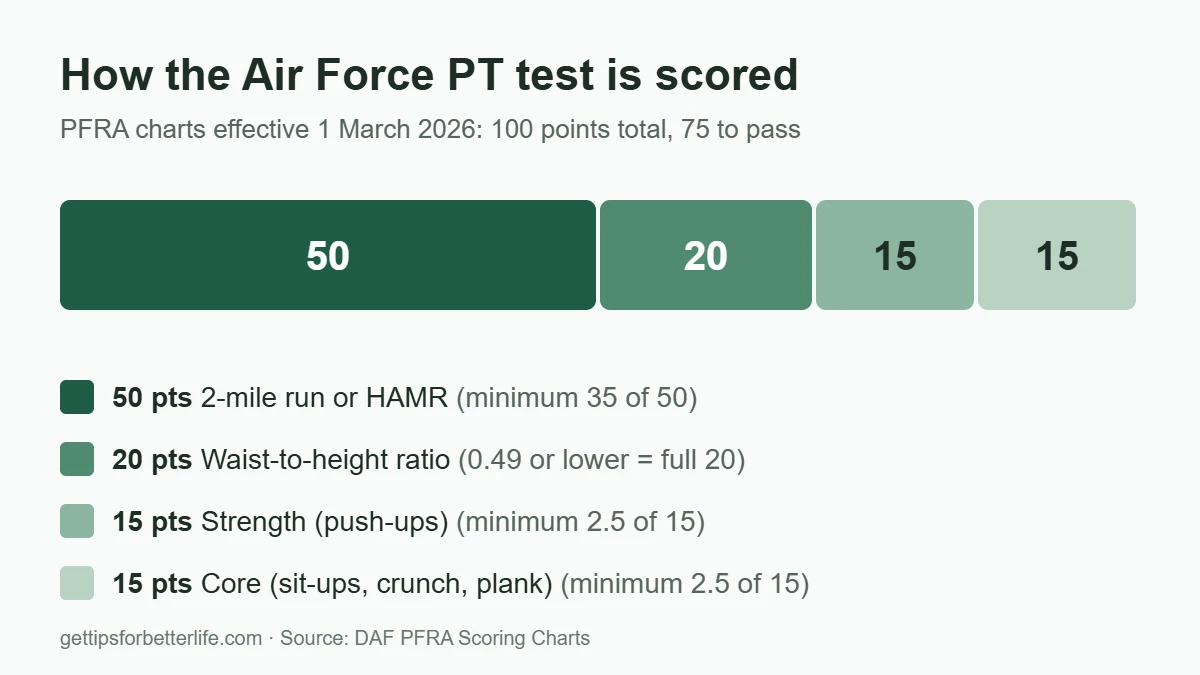
The test has four parts and is worth 100 points. You pass with a composite of 75 or higher, and you also have to meet the minimum on each timed or counted event. Miss one minimum and it’s a fail, even with 80 points.
- Cardio, 50 points: a 2-mile run or the 20-meter High Aerobic Multi-Shuttle Run (HAMR). The minimum is 35 points.
- Body composition, 20 points: your waist-to-height ratio (WHtR). It uses one chart for everyone.
- Strength, 15 points: push-ups in 1 minute or hand-release push-ups in 2 minutes. The minimum is 2.5 points.
- Core, 15 points: sit-ups in 1 minute, cross-leg reverse crunches in 2 minutes, or a forearm plank held as long as you can. The minimum is 2.5 points.
Each event is scored by age group (under 25, then five-year bands up to 60 and over) and by sex. If your result falls between two chart rows, you get the lower row. So for a man under 25, 46 push-ups scores 8 points, and 45 push-ups scores 7.5.
Minimum standards by age
These are the lowest results that still earn points (2.5 points for strength and core, 35 for cardio). Anything below them is a fail for that component. Run times are the slowest allowed, and the plank is the shortest hold.
Men
| Age | Push-ups | Hand-release push-ups | Sit-ups | Reverse crunches | Plank | 2-mile run | HAMR |
|---|---|---|---|---|---|---|---|
| Under 25 | 30 | 27 | 33 | 35 | 1:35 | 19:45 | 42 |
| 25–29 | 28 | 25 | 31 | 33 | 1:30 | 19:55 | 42 |
| 30–34 | 26 | 23 | 29 | 31 | 1:25 | 20:44 | 38 |
| 35–39 | 23 | 21 | 27 | 29 | 1:20 | 21:16 | 36 |
| 40–44 | 21 | 19 | 25 | 27 | 1:15 | 22:04 | 32 |
| 45–49 | 19 | 17 | 23 | 25 | 1:10 | 22:27 | 31 |
| 50–54 | 17 | 15 | 21 | 23 | 1:05 | 22:50 | 30 |
| 55–59 | 14 | 13 | 19 | 21 | 1:00 | 23:36 | 27 |
| 60+ | 12 | 11 | 17 | 19 | 0:55 | 24:00 | 26 |
Women
| Age | Push-ups | Hand-release push-ups | Sit-ups | Reverse crunches | Plank | 2-mile run | HAMR |
|---|---|---|---|---|---|---|---|
| Under 25 | 15 | 17 | 29 | 33 | 1:30 | 25:23 | 21 |
| 25–29 | 14 | 15 | 25 | 31 | 1:25 | 25:40 | 20 |
| 30–34 | 12 | 13 | 20 | 29 | 1:20 | 26:15 | 19 |
| 35–39 | 11 | 11 | 18 | 27 | 1:15 | 26:30 | 18 |
| 40–44 | 10 | 9 | 16 | 25 | 1:10 | 26:52 | 17 |
| 45–49 | 8 | 7 | 10 | 23 | 1:05 | 27:15 | 16 |
| 50–54 | 7 | 5 | 9 | 21 | 1:00 | 28:05 | 14 |
| 55–59 | 5 | 3 | 7 | 19 | 0:55 | 28:40 | 13 |
| 60+ | 3 | 1 | 6 | 17 | 0:50 | 29:40 | 11 |
What it takes to max each event
These results earn full points: 15 for strength and core, 50 for cardio. Doing more than this won’t add anything.
Men
| Age | Push-ups | Hand-release push-ups | Sit-ups | Reverse crunches | Plank | 2-mile run | HAMR |
|---|---|---|---|---|---|---|---|
| Under 25 | 67 | 52 | 58 | 60 | 3:40 | 13:25 | 87 |
| 25–29 | 63 | 50 | 56 | 58 | 3:35 | 13:35 | 85 |
| 30–34 | 60 | 48 | 54 | 56 | 3:30 | 13:42 | 84 |
| 35–39 | 56 | 46 | 52 | 54 | 3:25 | 13:56 | 82 |
| 40–44 | 52 | 44 | 50 | 52 | 3:20 | 14:05 | 81 |
| 45–49 | 49 | 42 | 48 | 50 | 3:15 | 14:30 | 77 |
| 50–54 | 45 | 40 | 46 | 48 | 3:10 | 15:09 | 71 |
| 55–59 | 42 | 38 | 44 | 46 | 3:05 | 15:28 | 69 |
| 60+ | 38 | 36 | 42 | 44 | 3:00 | 16:58 | 65 |
Women
| Age | Push-ups | Hand-release push-ups | Sit-ups | Reverse crunches | Plank | 2-mile run | HAMR |
|---|---|---|---|---|---|---|---|
| Under 25 | 50 | 42 | 54 | 58 | 3:35 | 15:30 | 68 |
| 25–29 | 47 | 40 | 50 | 56 | 3:30 | 15:55 | 65 |
| 30–34 | 44 | 38 | 45 | 54 | 3:25 | 16:10 | 63 |
| 35–39 | 42 | 36 | 43 | 52 | 3:20 | 16:12 | 63 |
| 40–44 | 39 | 34 | 41 | 50 | 3:15 | 16:45 | 59 |
| 45–49 | 36 | 32 | 35 | 48 | 3:10 | 16:55 | 58 |
| 50–54 | 34 | 30 | 34 | 46 | 3:05 | 17:10 | 57 |
| 55–59 | 31 | 28 | 32 | 44 | 3:00 | 17:43 | 53 |
| 60+ | 28 | 26 | 31 | 42 | 2:55 | 18:20 | 50 |
Waist-to-height ratio scoring
Divide your waist by your height, using the same unit for both, and round to two decimals. A ratio of 0.49 or lower earns all 20 points. Each 0.01 above that costs a point at first, then 2.5 points from 0.55 on. At 0.60 or above you score zero for this part.

The waist-to-height chart has no minimum, unlike the other events. A zero still hurts, though: it means the other three parts have to supply all 75 points, and they can supply 80 at most.
The calculator rounds your ratio to two decimals before it looks up points. Measure carefully. Half an inch can move you a full row. For someone 69 inches tall, a 34-inch waist gives 0.49 (20 points) and a 36-inch waist gives 0.52 (17 points).
Example: one point short
Take a 23-year-old man who is 69 inches tall with a 36-inch waist. He does 45 push-ups, 45 sit-ups and runs 2 miles in 16:30.
- Waist-to-height 0.52: 17 points
- 45 push-ups: 7.5 points
- 45 sit-ups: 8.5 points
- 16:30 run: 41 points
That adds up to 74. Every minimum is met, but he fails by one point. One more push-up (46) and one more sit-up (46) would each add half a point and take him to 75. Taking 15 seconds off the run, to 16:15, would add a full point on its own. That’s why the calculator shows the next scoring step under each event. It points you to the easiest points.
The 2-kilometer walk
The 2-km walk is a pass or fail cardio option, usually for members whose medical profile keeps them off the run and the HAMR. It isn’t worth any points. You pass if you finish under the maximum time for your age and sex.
| Age | Men, max time | Women, max time |
|---|---|---|
| Under 30 | 16:16 | 17:22 |
| 30–39 | 16:18 | 17:28 |
| 40–49 | 16:23 | 17:49 |
| 50–59 | 16:40 | 18:11 |
| 60+ | 16:58 | 18:53 |
When you walk, the calculator scales your other three components, which are worth 50 points, up to a score out of 100. This follows the usual rule for exempt components, where your score is points earned divided by points possible. Check with your unit Fitness Program Manager for how your own profile is handled.
When the new charts apply
The charts are dated 17 March 2026 and were effective from 1 March 2026, the start of a diagnostic period. Airmen could take the new test and, if they chose, count the result. Official scoring under these standards began on 1 July 2026, and the test is taken twice a year. The Air Force has said the tables may be adjusted after it reviews the diagnostic data, so check that your numbers match the latest chart before test day.
Tips to raise your score
- Work on the run first. Near the middle of the chart, each step is about 19 seconds and worth a full point, and cardio carries half the test.
- Try the other event options. Many people score better on hand-release push-ups or the reverse crunch than on the standard version. Put both into the calculator and compare.
- Remember the waist points. Bringing a 0.55 ratio down to 0.52 adds 4.5 points without any change in your reps.
- Practice in test conditions. Same cadence, same form standard, same timer as the real test.
Frequently asked questions
What score do you need to pass the Air Force PT test?
You need a composite of at least 75 out of 100, and you must meet the minimum on strength, core and cardio. A total of 75 or more with one event below its minimum is still a fail.
How many push-ups do you need for the Air Force PT test?
For men under 25 the minimum is 30 push-ups in one minute and 67 earns the full 15 points. For women under 25 it is 15 to pass and 50 to max. The minimums drop with each age group, as the tables above show.
What is a passing 2-mile run time for the Air Force?
The slowest scoring time for men under 25 is 19:45, and for women under 25 it is 25:23. Running 13:25 (men) or 15:30 (women) earns the full 50 points in that age group.
How is waist-to-height ratio scored in the PFRA?
Divide your waist by your height and round to two decimals. A ratio of 0.49 or less earns 20 points, 0.52 earns 17, 0.55 earns 12.5 and 0.60 or more earns zero. The chart is the same for every age and sex.
Is this calculator official?
No. It uses the published Department of the Air Force scoring charts, but your Fitness Assessment Cell and your myFitness record have the final say. If the charts are updated, the official tables take priority.
Sources
- Department of the Air Force. Physical Fitness Readiness Assessment Scoring Charts, effective 1 March 2026 (chart release dated 17 March 2026).
- Department of the Air Force. Fitness program memorandum, signed 23 September 2025. AFPC (PDF).
- Aviation A2Z. US Air Force updates PFRA scoring charts for new fitness test, March 2026.
- Air & Space Forces Magazine. Air Force physical fitness assessment coverage.
Related calculators
- Army height and weight calculator: the Army’s 2026 waist-to-height check.
- Rucking calorie calculator: calories burned carrying a pack.
- Heart rate zone calculator: training zones for run work.