
Rucking Calorie Calculator
This rucking calorie calculator estimates how many calories you burn walking with a weighted pack. Enter your body weight, pack weight, distance, time and surface. It uses the Pandolf equation, which came out of US Army load-carrying research, and also shows how much the pack itself added compared with the same walk without it.
Rucking calorie calculator
Estimates calories burned walking with a weighted pack, using the Pandolf equation from US Army research. Free, nothing saved.
How the calculator works
The calculator uses the Pandolf equation (Pandolf, Givoni and Goldman, 1977). It predicts the energy cost of standing and walking from five things: your body weight, the load you carry, your walking speed, the slope and the type of ground.
In watts, the equation is: M = 1.5W + 2.0(W + L)(L/W)² + η(W + L)(1.5V² + 0.35VG), where W is body weight in kg, L is pack weight in kg, V is speed in meters per second, G is grade in percent and η (eta) is a terrain factor. The calculator multiplies the result by your time and converts it to kilocalories (1 kcal = 4,184 joules).
Your speed comes from distance divided by time. If you enter a total climb, the calculator spreads it over the whole route as an average grade. The terrain factors are the standard ones used with this equation, from 1.0 for a paved road up to 2.1 for loose sand.
Example: a 3-mile ruck with a 30-lb pack
Take a 180-lb person who carries a 30-lb pack for 3 miles on a paved road in 1 hour (a 20-minute mile). The calculator gives about 331 kcal. The same walk without the pack comes out at about 295 kcal, so the pack added roughly 36 kcal.

Move that same ruck to a dirt trail with 300 feet of climbing and the estimate rises to about 433 kcal. The hill and the softer ground made a bigger difference than the pack did.
What changes your calorie burn the most
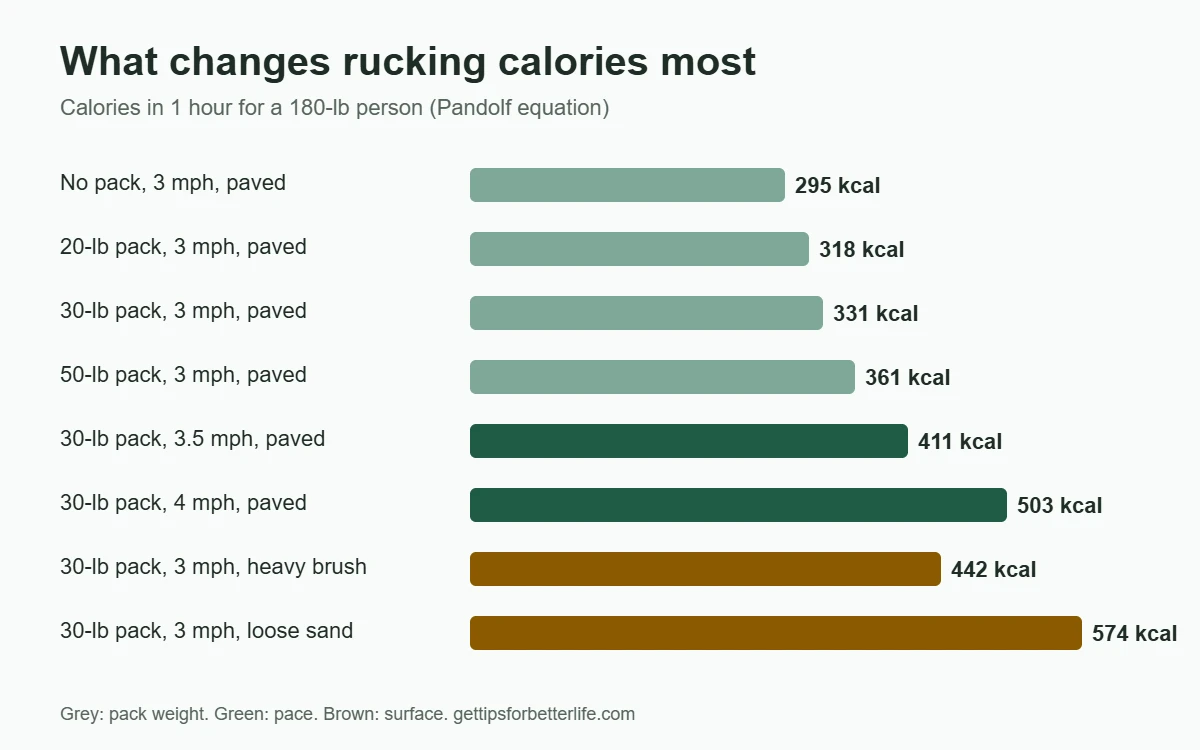
Using the same 180-lb person walking for one hour, here is how each factor moves the estimate when the others stay the same.
| Change (1 hour, 180-lb person) | Calories |
|---|---|
| No pack, 3 mph, paved | 295 |
| 20-lb pack, 3 mph, paved | 318 |
| 30-lb pack, 3 mph, paved | 331 |
| 50-lb pack, 3 mph, paved | 361 |
| 30-lb pack, 3.5 mph, paved | 411 |
| 30-lb pack, 4 mph, paved | 503 |
| 30-lb pack, 3 mph, heavy brush | 442 |
| 30-lb pack, 3 mph, loose sand | 574 |
Going from no pack to 50 lb adds about 66 kcal an hour. Speeding up from 3 to 4 mph with a 30-lb pack adds about 170 (you also cover a mile more), and switching from pavement to loose sand adds about 240. In this equation, pace and ground matter far more than the extra pounds.
What this estimate leaves out
The Pandolf equation counts the work of walking uphill but gives no extra cost for walking downhill, so a hilly out-and-back route will come out a little low. It also assumes steady walking. Stops, a poorly fitted pack or very uneven ground all change the real number.
A 2022 study from US Army researchers (Looney and colleagues, Medicine and Science in Sports and Exercise) found that existing equations underestimate the energy cost of heavy military loads. Treat the result as a conservative estimate rather than an exact count, and use it to compare one ruck with another.
Frequently asked questions
How many calories does rucking burn in an hour?
It depends mostly on your weight, pace and the ground. A 180-lb person carrying 30 lb at 3 mph on pavement burns about 331 kcal an hour by the Pandolf equation. At 4 mph the same person burns about 503.
Does pack weight or speed matter more?
Speed and terrain have the bigger effect in this equation. Adding 20 lb to a 30-lb pack raises the hourly estimate by about 30 kcal, while walking 1 mph faster raises it by about 170.
Does the calculator count walking downhill?
No. It adds the cost of climbing, based on your total climb, but the original equation has no downhill term. Routes with long descents will be slightly underestimated.
Can I use it for running with a pack?
No. The Pandolf equation was built from walking tests, so the calculator stops at about 5.6 mph (9 km/h). Above roughly 4.5 mph it warns that you may be close to jogging.
Is my information saved?
No. The calculation runs in your browser and nothing is stored or sent anywhere.
Related tools
- Walking time calculator
- Walking calorie calculator
- Steps to calories calculator
- Army height and weight calculator
Sources
- Pandolf KB, Givoni B, Goldman RF. Predicting energy expenditure with loads while standing or walking very slowly. Journal of Applied Physiology. 1977;43(4):577-581.
- Looney DP, Lavoie EM, Vangala SAIV, et al. Modeling the metabolic costs of heavy military backpacking. Medicine and Science in Sports and Exercise. 2022;54(4):646-654.
- Pandolf equation and terrain factors: Wikipedia summary
This calculator gives general estimates for information only and is not medical advice.