
Biological Age Calculator
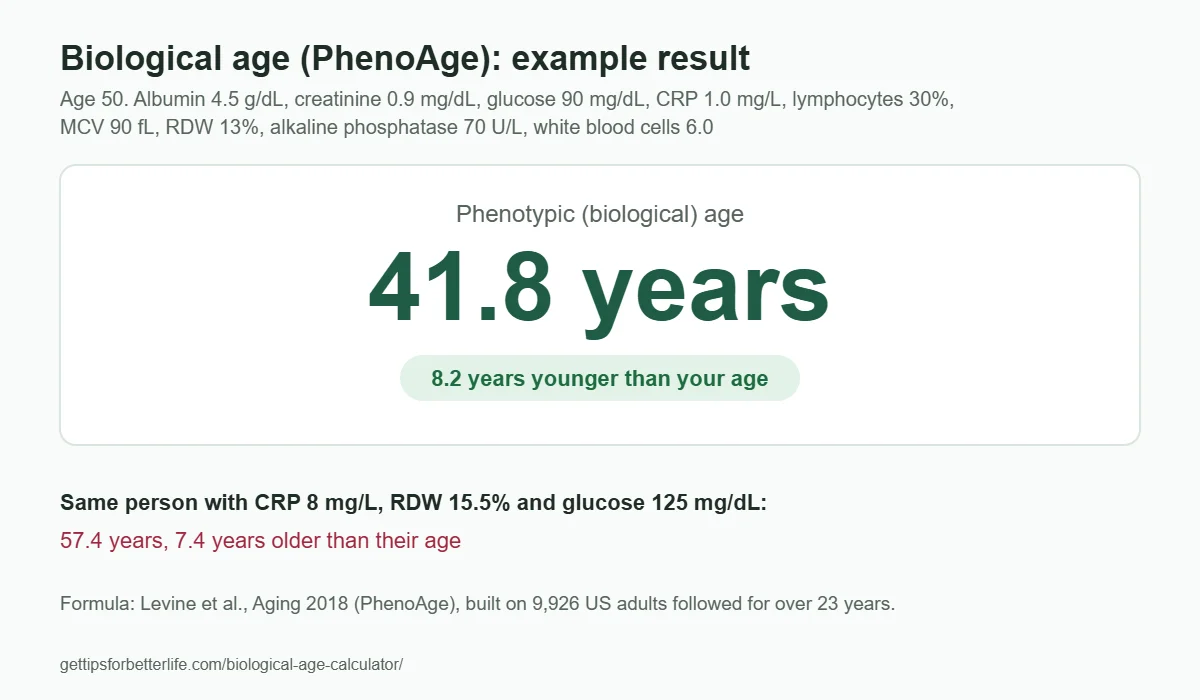
Your biological age is an estimate of how old your body is working, as opposed to how many birthdays you have had. This calculator uses PhenoAge, a published formula that turns nine results from a routine blood test, plus your age, into a biological age in years.
Biological age calculator (PhenoAge, from a blood test)
Enter your age and nine results from a routine blood test. Free, nothing saved.
Where to find the nine numbers
All nine markers come from three common tests. If your last checkup included a comprehensive metabolic panel, a complete blood count with differential and a CRP, you already have them.
| Marker | Which test it is on | Units used here |
|---|---|---|
| Albumin | Comprehensive metabolic panel (CMP) | g/dL (or g/L) |
| Creatinine | CMP or basic metabolic panel | mg/dL (or µmol/L) |
| Glucose, fasting | CMP or basic metabolic panel | mg/dL (or mmol/L) |
| Alkaline phosphatase | CMP (liver tests) | U/L |
| C-reactive protein (CRP) | Separate test, often hs-CRP | mg/L |
| Lymphocytes | Complete blood count (CBC) with differential | % |
| Mean cell volume (MCV) | CBC | fL |
| Red cell distribution width (RDW) | CBC | % |
| White blood cells (WBC) | CBC | ×1000 per µL |
Two things trip people up. If your CRP is reported in mg/dL, multiply it by 10 to get mg/L. If the report says something like “under 0.3”, enter 0.3. Use a fasting glucose if you have one.

How PhenoAge works
Morgan Levine and colleagues built PhenoAge in 2018 using data from 9,926 adults in the US National Health and Nutrition Examination Survey (NHANES III), who were followed for more than 23 years. Out of 42 lab markers, a statistical model picked the nine that, together with age, best predicted the risk of dying over the following ten years. The formula then converts that risk into the age at which an average person would carry the same risk.
So a PhenoAge of 45 for a 50-year-old means their blood profile looks like that of a typical 45-year-old. The markers that weigh most are red cell distribution width (RDW), fasting glucose, CRP (inflammation), white blood cell count and albumin.
What can move your result
- Blood sugar: glucose carries one of the biggest weights, so steady blood sugar helps.
- Inflammation: CRP rises with infections, poor sleep, smoking and extra body fat. Do the test when you are well, not just after a cold.
- Body fat around the middle: visceral fat is linked to higher CRP and glucose. Our visceral fat calculator estimates yours.
- Activity: regular moderate exercise tends to improve glucose and inflammation markers over months.
Treat one result as a snapshot. Comparing results from tests a year apart tells you far more.
Limits of this estimate
- It is an estimate of mortality risk, not a diagnosis. A normal-range result on every marker can still give an older PhenoAge, and the reverse.
- It was built on US adults. Results for other groups may be less accurate.
- Lab methods differ, so small changes between two labs may not mean anything.
- It does not replace advice from your doctor about any result outside the reference range on your report.
Frequently asked questions
What is a good biological age?
Anything at or below your actual age is a good result. A PhenoAge several years younger than your age suggests your blood markers look like those of a younger person. What matters most is whether it improves over time.
How accurate is a biological age calculator?
PhenoAge is one of the better-studied formulas because it was built and tested on a large US survey with long follow-up. It still only reflects nine blood markers on one day, so treat it as a rough guide, not an exact number.
Can I calculate biological age without a blood test?
Some calculators use questionnaires or fitness tests, but those are not validated the way PhenoAge is. For a number based on published research, you need the nine blood results.
Which blood tests do I need?
A comprehensive metabolic panel (albumin, creatinine, glucose, alkaline phosphatase), a complete blood count with differential (lymphocytes, MCV, RDW, white blood cells) and a C-reactive protein test.
Can I lower my biological age?
Your PhenoAge can change as the markers change. Better blood sugar control, lower inflammation and less belly fat all move it in the right direction, which is why tracking it once a year is useful.
Related tools
Sources
- Levine ME, Lu AT, Quach A, et al. An epigenetic biomarker of aging for lifespan and healthspan. Aging (Albany NY). 2018;10(4):573–591. doi:10.18632/aging.101414 (Phenotypic Age formula and NHANES III data, Table 1 and supplement)
Last updated: 7 November 2026. This tool gives an estimate for general information and is not medical advice.