
Visceral Fat Calculator
Enter your age, height, weight, waist and upper thigh to estimate your visceral fat area in cm². The calculator uses the Samouda equation, which was checked against CT scans, and also gives your waist-to-height ratio as a quick second check.
Visceral fat calculator
Estimates visceral fat area from a tape measure. Free, no sign-up, nothing saved.
How to measure your waist and upper thigh
The result depends on these two numbers, so it’s worth taking them carefully. Use a soft tape, stand relaxed, and breathe out normally before you read the tape.
- Waist: measure around your middle at the level of your belly button. Keep the tape level all the way round, snug but not pressing into the skin.
- Upper (proximal) thigh: measure one thigh just below the crease of the buttock, where the thigh is widest. Stand with your weight on both feet and the leg relaxed.
- Take each measurement twice. If the two readings differ by more than half an inch (1 cm), take a third and use the average.

How the calculation works
Visceral fat is the fat packed around the organs inside your abdomen. A tape around the waist picks up all belly fat, both the visceral fat inside and the fat just under the skin. Hanen Samouda and colleagues found that the upper thigh measurement tracks the fat under the skin closely. So their equation starts from the waist and subtracts a thigh term, which leaves an estimate of the visceral part.
They built and tested it on 253 adults aged 18 to 78, with BMIs from 16 to 53, whose visceral fat was measured by CT scan. These are the equations (measurements in cm, BMI in kg/m², result in cm²):
- Women: VAT = (2.15 × waist) − (3.63 × thigh) + (1.46 × age) + (6.22 × BMI) − 92.713
- Men: VAT = (6 × waist) − (4.41 × thigh) + (1.19 × age) − 213.65
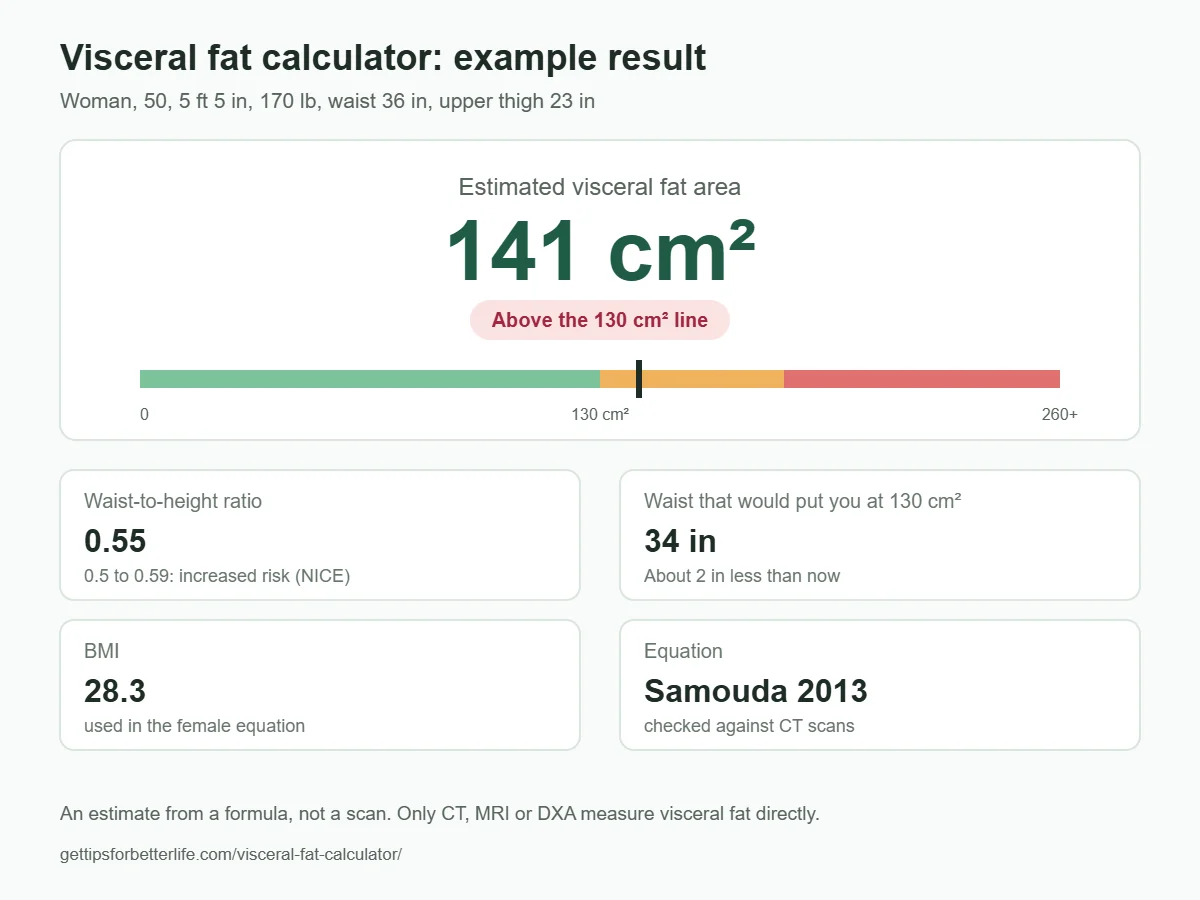
Worked example: a woman of 50 with a 91.4 cm (36 in) waist, a 58.4 cm (23 in) thigh and a BMI of 28.3 gets 196.6 − 212.1 + 73.0 + 176.0 − 92.7 = about 141 cm².
What the 130 cm² line means
There’s no official “normal” visceral fat number. The figure used most often is 130 cm², from a 1994 study by Hunter and colleagues. At that level, the risk of high blood pressure and blood sugar problems went up. The calculator marks results of 100 to 129 cm² as close to the line, and 130 or more as above it.
The tool also shows the waist size that would bring your estimate to 130 cm² if your other measurements stayed the same. Treat it as a direction, not a goal weight, because your thigh and BMI usually change too when you lose fat.
Waist-to-height ratio: the quick check
If you only have a waist measurement, divide it by your height. In 2022 the UK’s National Institute for Health and Care Excellence (NICE) advised keeping your waist to less than half your height:
| Waist-to-height ratio | What NICE says |
|---|---|
| 0.40 to 0.49 | Healthy, no increased risk |
| 0.50 to 0.59 | Increased health risk |
| 0.60 or more | High risk |
What actually lowers visceral fat
A 2013 review of exercise trials in PLoS One found that exercise on its own, without a calorie-cutting diet, can reduce visceral fat. The training needed to be at least moderate to vigorous, such as brisk walking, cycling or jogging. Adding strength training to aerobic training didn’t reduce visceral fat any further in those trials.
Weight loss of any kind tends to take visceral fat with it. Our calorie deficit calculator helps you set a realistic daily target, and the weight loss percentage calculator tracks your progress. Re-measure your waist and thigh every four to six weeks and run this calculator again.
Limits of this estimate
- It’s a formula, not a scan. Only CT, MRI or DXA measure visceral fat directly.
- It was built on adults aged 18 to 78 with a BMI of 16 to 53, mostly from southern Europe. Results outside that group are rougher.
- A small error in the tape reading moves the result, especially for men, because the waist is multiplied by 6.
- It doesn’t diagnose anything. If you’re worried about your weight, blood pressure or blood sugar, talk to your doctor.
Frequently asked questions
How do I calculate my visceral fat at home?
Measure your waist at the belly button and your upper thigh just below the buttock, then enter them with your age, height and weight in the calculator above. It applies the Samouda equation and gives an estimate in cm².
Is 7.5 visceral fat good?
A number like 7.5 comes from a body composition scale, not from this calculator. Tanita scales, for example, rate visceral fat from 1 to 59, and call 1 to 12 a healthy level and 13 to 59 an excess level. On that scale, 7.5 is in the healthy band. Scale ratings and cm² results aren’t interchangeable.
What is a normal amount of visceral fat?
There’s no agreed normal range in cm². Most tools, including this one, use 130 cm² as the point where health risk rises, based on Hunter and colleagues (1994).
Why does the calculator need my thigh?
Your waist includes fat under the skin as well as visceral fat. The upper thigh measurement estimates the fat under the skin, so subtracting it gives a better estimate of the visceral part than the waist alone.
Can I lower visceral fat without dieting?
A 2013 meta-analysis found that moderate to vigorous exercise reduced visceral fat even without a calorie-cutting diet. Combining exercise with a modest calorie deficit usually works faster.
Related tools
- Waist-to-hip ratio calculator
- Body fat calculator
- Calorie deficit calculator
- Walking calorie calculator
Sources
- Samouda H, Dutour A, Chaumoitre K, et al. VAT=TAAT-SAAT: innovative anthropometric model to predict visceral adipose tissue without resort to CT-scan or DXA. Obesity. 2013;21(1):E41–E50. doi:10.1002/oby.20033
- Samouda H. Commentary: Anthropometric indicators as a tool for diagnosis of obesity and other health risk factors. Front Psychol. 2021. PMC8481814 (gives the equations and the 130 cm² cut-off)
- Hunter GR, et al. (1994): 130 cm² visceral fat threshold for higher cardiometabolic risk, as cited in Samouda 2021 above.
- Vissers D, Hens W, Taeymans J, et al. The effect of exercise on visceral adipose tissue in overweight adults: a systematic review and meta-analysis. PLoS One. 2013;8(2):e56415. PMC3568069
- NICE (2022). Keep your waist to less than half your height (waist-to-height ratio categories).
- Tanita / Garmin BC-1000 user manual: visceral fat rating 1–59 (1–12 healthy, 13–59 excess).
Last updated: 6 November 2026. This tool gives an estimate for general information and isn’t medical advice.