
Army Height and Weight Calculator
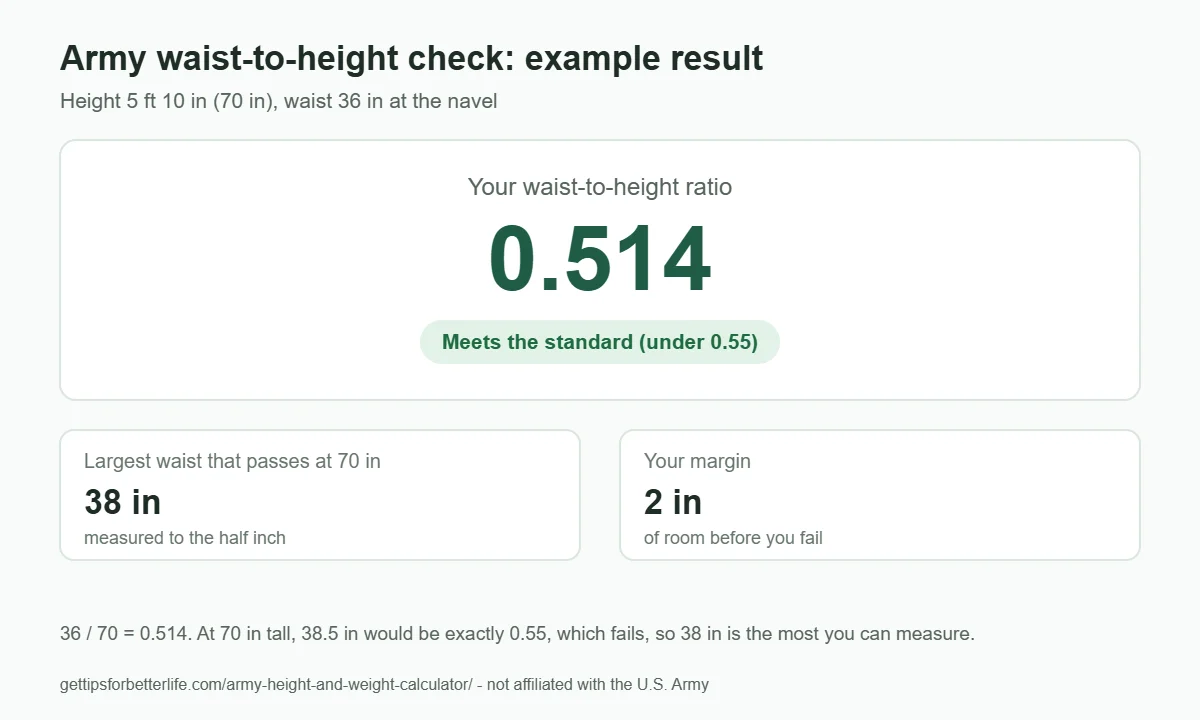
Since July 2026 the Army no longer uses height and weight tables or the tape test. It checks one number: your waist at the navel divided by your height, which must be under 0.55. Enter your height and waist to see your ratio, the largest waist that passes for your height, and how much room you have.
Army height and weight calculator (2026 waist-to-height check)
Uses the Army’s July 2026 standard: waist at the navel divided by height must be under 0.55. Free, nothing saved.
What changed in July 2026
On 1 July 2026 the Secretary of the Army signed Army Directive 2026-13, and the Army announced it on 7 July. It replaced the height and weight tables, the circumference tape test and the supplemental body fat scans with a single waist-to-height ratio (WHtR). The standard is the same for every Soldier, whatever their age or sex.
| Before July 2026 | Now (AD 2026-13) | |
|---|---|---|
| First screen | Height and weight table by age and sex | Waist at the navel divided by height |
| If you were over | Tape test for body fat % | Second WHtR measurement by a different team the same day |
| Pass mark | Body fat % limit by age and sex | Under 0.55 for everyone |
| Fitness test exemption | High fitness test scores could exempt you | No score exempts anyone |
| Body fat scans to challenge a result | Allowed in some cases | Not used to challenge a WHtR result |
So when people search for an Army height and weight calculator now, the check that matters is this ratio. Your weight no longer goes into it at all.
Maximum waist by height
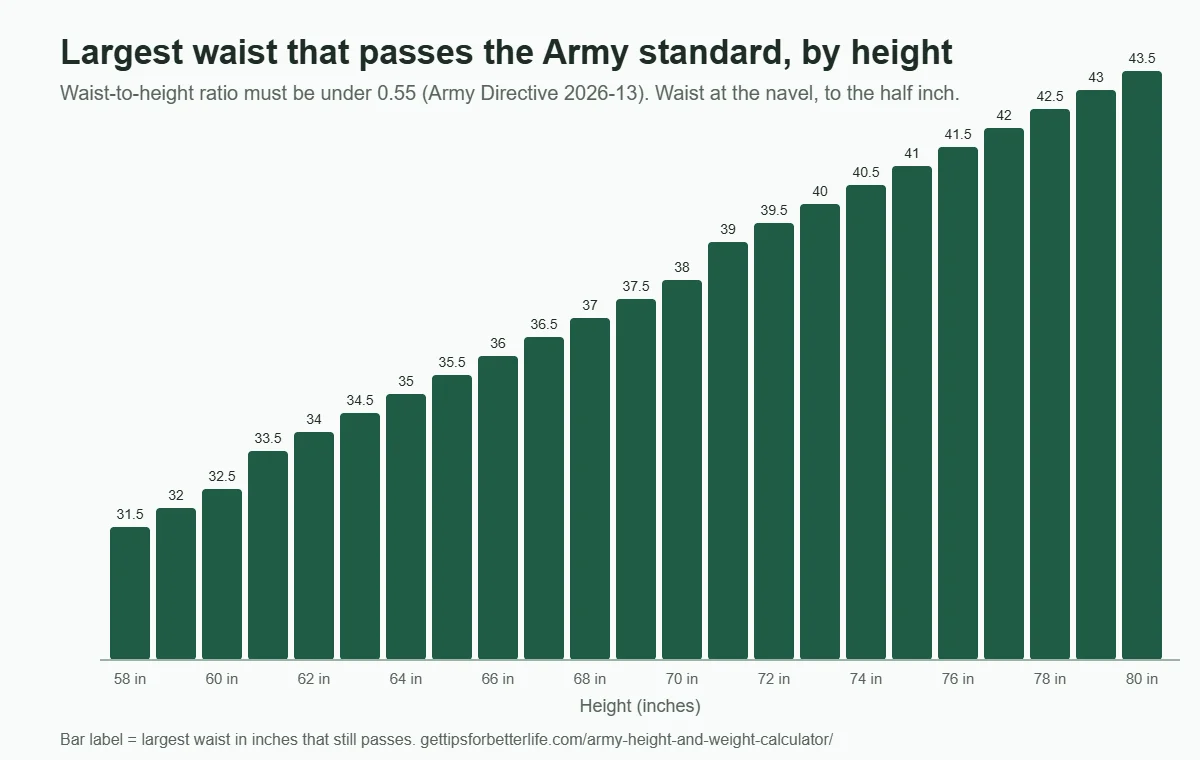
The ratio has to stay below 0.55, so a result of exactly 0.55 fails. Measured to the half inch, these are the largest waists that pass:
| Height | Largest waist that passes | Waist that fails |
|---|---|---|
| 4 ft 10 in (58 in) | 31.5 in (80.0 cm) | 32 in |
| 4 ft 11 in (59 in) | 32 in (81.3 cm) | 32.5 in |
| 5 ft 0 in (60 in) | 32.5 in (82.5 cm) | 33 in |
| 5 ft 1 in (61 in) | 33.5 in (85.1 cm) | 34 in |
| 5 ft 2 in (62 in) | 34 in (86.4 cm) | 34.5 in |
| 5 ft 3 in (63 in) | 34.5 in (87.6 cm) | 35 in |
| 5 ft 4 in (64 in) | 35 in (88.9 cm) | 35.5 in |
| 5 ft 5 in (65 in) | 35.5 in (90.2 cm) | 36 in |
| 5 ft 6 in (66 in) | 36 in (91.4 cm) | 36.5 in |
| 5 ft 7 in (67 in) | 36.5 in (92.7 cm) | 37 in |
| 5 ft 8 in (68 in) | 37 in (94.0 cm) | 37.5 in |
| 5 ft 9 in (69 in) | 37.5 in (95.3 cm) | 38 in |
| 5 ft 10 in (70 in) | 38 in (96.5 cm) | 38.5 in |
| 5 ft 11 in (71 in) | 39 in (99.1 cm) | 39.5 in |
| 6 ft 0 in (72 in) | 39.5 in (100.3 cm) | 40 in |
| 6 ft 1 in (73 in) | 40 in (101.6 cm) | 40.5 in |
| 6 ft 2 in (74 in) | 40.5 in (102.9 cm) | 41 in |
| 6 ft 3 in (75 in) | 41 in (104.1 cm) | 41.5 in |
| 6 ft 4 in (76 in) | 41.5 in (105.4 cm) | 42 in |
| 6 ft 5 in (77 in) | 42 in (106.7 cm) | 42.5 in |
| 6 ft 6 in (78 in) | 42.5 in (108.0 cm) | 43 in |
| 6 ft 7 in (79 in) | 43 in (109.2 cm) | 43.5 in |
| 6 ft 8 in (80 in) | 43.5 in (110.5 cm) | 44 in |
How to measure your waist and height
- Height: barefoot, heels against a wall, looking straight ahead. Lay a flat book on your head, mark the wall and measure from the floor.
- Waist: tape around your waist at the navel (belly button), level all the way round, snug but not pressing in. Read it after a normal breath out.
- Measure twice. If the readings differ, measure a third time and use the middle one.

What happens if you are at 0.55 or higher
- A different team measures you again on the same duty day before your commander does anything.
- If the second result is also 0.55 or higher, you are enrolled in the Army Body Composition Program (ABCP).
- Every Soldier is assessed twice a year, and commanders can order a check at any time.
- The directive gave units 90 days to record a WHtR for every Soldier.
- The Army is running a 180-day review of the new standard, and no Soldier will be separated for a WHtR failure until that review is done and new guidance is issued.
How to bring your waist down
Waist size follows belly fat, and much of that is visceral fat. A 2013 meta-analysis found that moderate to vigorous exercise reduced visceral fat even without dieting. A modest calorie deficit speeds it up. Our visceral fat calculator estimates how much deep belly fat you carry, and the calorie deficit calculator helps you set a daily target. Re-measure every two to three weeks, at the same time of day.
Not in the Army?
Waist-to-height ratio is a useful health check for anyone. The UK health body NICE advises keeping your waist to less than half your height (a ratio under 0.5), which is stricter than the Army line. See also our waist-to-hip ratio calculator.
In the Air Force instead? Its 2026 fitness test also scores waist-to-height, worth 20 of 100 points. Our Air Force PT calculator scores that plus push-ups, core and the 2-mile run from the official charts.
Frequently asked questions
Does the Army still use height and weight tables?
No. Army Directive 2026-13 (July 2026) rescinded the height and weight screening tables and the tape test. The Army now uses only the waist-to-height ratio.
What is the maximum waist for 5 ft 10 in?
At 70 inches, 0.55 times 70 is 38.5 inches, and a result of exactly 0.55 fails. Measured to the half inch, the largest passing waist is 38 inches.
Do age or sex change the standard?
No. The 0.55 line is the same for all Soldiers, whatever their age or sex.
Does a high fitness test score exempt me?
No. Under the 2026 directive no Army Fitness Test score exempts a Soldier from the waist-to-height standard.
Can I ask for a tape test or body fat scan instead?
No. The directive says tape tests and other body fat assessments are not used to challenge a WHtR result. A failing first result gets a second WHtR measurement by a different team.
Sources
- U.S. Army. Army modifies body composition program, adopts waist to height ratio. army.mil, 7 July 2026.
- Army Directive 2026-13 (Army Body Composition Program and Standards), signed 1 July 2026.
- Vissers D, et al. The effect of exercise on visceral adipose tissue in overweight adults. PLoS One. 2013;8(2):e56415.
- NICE (2022). Keep your waist to less than half your height.
Last updated: 7 November 2026. This calculator is for planning only and is not affiliated with or endorsed by the U.S. Army. The official measurement by your unit is what counts.