Acid Reflux at Night: Why It Happens and How to Actually Stop It

Quick answer
Nighttime acid reflux happens because lying down removes gravity’s help in keeping stomach acid down, and sleep slows the swallowing and saliva production that normally clear acid out of your esophagus. Eating late, certain foods, extra weight around the middle, and — for women who use menopausal hormone therapy — a research-linked higher GERD risk can all make it worse. A few changes to timing and sleep position fix it for most people; if it’s happening more than twice a week or disrupting sleep regularly, that’s the point to see a doctor rather than just stocking up on antacids. If night sweats or hot flashes also wake you, a free hot flash tracker helps you spot patterns to show your doctor.
Try this tonight — before you reach for anything, try this for one night:
- Stop eating 3 hours before bed, not just “a light snack” — a full stomach at bedtime is the single biggest trigger.
- Raise the head of your bed 6–8 inches (a wedge pillow works better than stacking regular pillows, which can bend you at the waist and make it worse).
- Sleep on your left side. Some research suggests this keeps the stomach positioned below the esophagus, so acid has to fight gravity to rise. Right-side sleeping tends to make reflux worse.
If you do all three and still wake up with burning, it’s less likely to be “just something you ate” and worth tracking for a pattern.
Why reflux gets worse specifically at night
During the day, gravity is doing you a favor — it helps keep stomach acid where it belongs. Lying flat removes that help completely. On top of that, you swallow far less often while asleep, and swallowing is how your esophagus normally clears any acid that does creep up. Saliva production also drops overnight, and saliva is mildly alkaline, so it usually helps neutralize acid during the day. Take away gravity, swallowing, and saliva all at once, and the same amount of stomach acid that you’d barely notice at noon can sit against your esophagus for hours at 2 a.m.
What’s actually causing it
Eating too close to bedtime. A full stomach puts more pressure on the valve between your stomach and esophagus (the lower esophageal sphincter, or LES), making it easier for acid to slip through.
Trigger foods and drinks. Spicy and fatty foods, citrus, tomato-based sauces, chocolate, caffeine, and alcohol are the most consistently reported triggers — not because they’re “acidic” themselves, but because several of them relax the LES directly.
Extra weight around the abdomen. Even without major weight gain, added pressure in the abdomen pushes up on the stomach and makes reflux more likely — one reason reflux often gets more noticeable in the decade or two after 40, when weight tends to redistribute toward the midsection. (Related: gaining belly fat after 40)
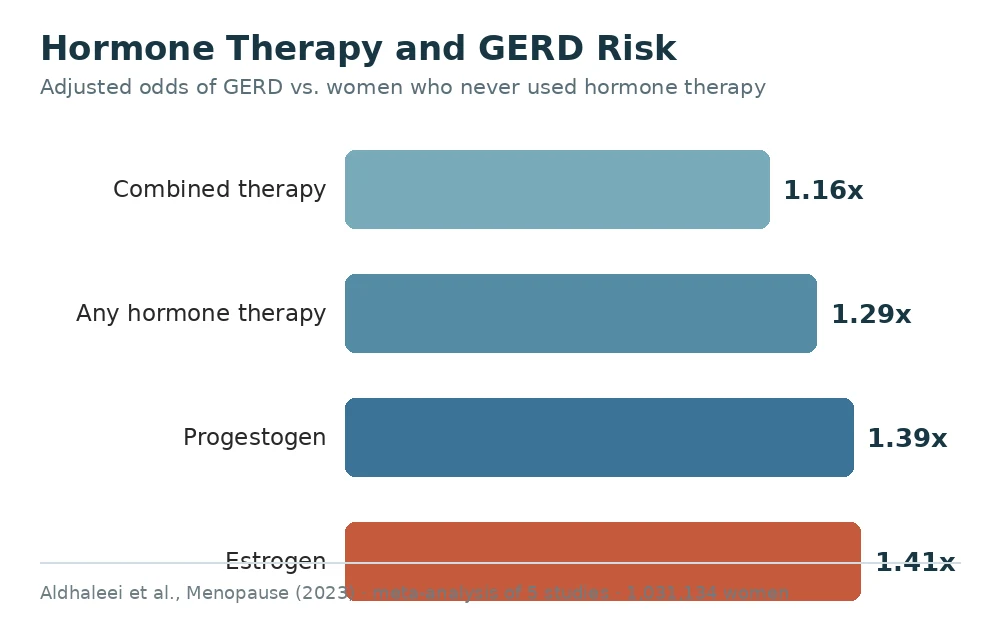
Hormone therapy. This is the piece that’s genuinely specific to women in this age range: a 2023 review of studies covering over a million women found that those who had ever used menopausal hormone therapy had about 29% higher odds of developing GERD than women who hadn’t, with estrogen, progestogen, and combined formulations all associated with increased risk. Why this happens isn’t settled. One idea is that these hormones relax the valve at the bottom of the esophagus. If you’re on hormone therapy and your reflux started or got worse after you began, it’s worth raising with your doctor.
A hiatal hernia. This is when part of the stomach pushes up through the diaphragm, and it becomes more common with age. It doesn’t always cause symptoms, but when it does, nighttime reflux is one of the most common complaints.
Smoking and alcohol. Both relax the LES and reduce saliva production — a double hit for nighttime reflux specifically.
What helps vs. what just masks it
Antacids (like Tums) and acid reducers (like famotidine) can get you through a bad night, but relying on them more than twice a week without also fixing the underlying triggers is a sign to see a doctor rather than a long-term plan — frequent acid suppression can mask a worsening problem and isn’t meant for daily long-term use without medical guidance.
What actually changes the pattern, in roughly the order worth trying:
- Finishing meals 3+ hours before bed
- Raising the head of the bed (not just pillows under your head)
- Left-side sleeping
- Cutting back on the specific trigger foods above, one at a time, to find your own triggers (they’re not identical for everyone)
- Reducing alcohol, especially in the evening
- Addressing weight around the midsection if that’s a factor, with a doctor or dietitian rather than a crash approach
At a glance: nighttime reflux triggers
| Trigger | Why it matters at night | Easy to fix? |
|---|---|---|
| Eating within 3 hours of bed | Full stomach pressures the LES open | Yes — timing change only |
| Lying flat | Removes gravity’s help | Yes — wedge pillow/bed riser |
| Trigger foods (spicy, fatty, citrus, chocolate, caffeine, alcohol) | Relax the LES directly | Yes — one at a time |
| Menopausal hormone therapy | May relax LES, research-linked to ~29% higher GERD risk | Partial — track pattern, discuss with doctor |
| Abdominal weight | Increases pressure on the stomach | Gradual |
| Hiatal hernia | Structural, more common with age | Needs medical evaluation if symptomatic |
| Smoking | Relaxes LES, reduces saliva | Yes, but hard |
When to actually see a doctor
Lifestyle fixes solve this for most people. See a doctor if:
- Heartburn happens more than twice a week or regularly disrupts your sleep.
- Symptoms don’t improve after 2–3 weeks of the changes above.
- You have difficulty or pain swallowing, food feels like it’s “sticking,” or you’re losing weight without trying.
- You’re using antacids or acid reducers almost daily just to function.
- You have a persistent cough, hoarseness, or a sensation of a lump in your throat — reflux can affect your airway and voice without classic heartburn. It can also leave your nose blocked — see our guide to a stuffy nose without a cold.
- Chest pain is sudden, severe, radiates to your arm or jaw, or comes with shortness of breath or sweating — treat this as a possible heart issue and get checked immediately rather than assuming it’s reflux.
Also worth knowing: nighttime reflux tends to show up around the same time as other midlife sleep disruptions — if you’re also waking up around 3 a.m. for no clear reason, see waking up at 3 a.m. in menopause.
Frequently Asked Questions
Why is my acid reflux worse specifically at night compared to during the day?
Because lying down removes gravity’s help keeping acid in your stomach, and sleep slows the swallowing and saliva production that normally clear acid out of your esophagus during the day.
Can menopause cause or worsen acid reflux at night?
Possibly, but the clearest evidence is about hormone therapy: a 2023 review of studies with over a million women found that women who had used it had about 29% higher odds of GERD. Midlife weight gain around the middle also adds pressure on the stomach. If reflux started around the same time as hormone therapy or other changes, mention it to your doctor.
What’s the fastest way to calm nighttime heartburn once it’s already started?
Sit up rather than staying flat, sip water, and chew sugar-free gum — it increases saliva, which helps neutralize the acid sitting in your esophagus.
Is it bad to take antacids every night?
Using them occasionally is fine, but needing them nearly every night is a sign to address the underlying triggers (timing, position, diet) and talk to a doctor, rather than relying on them indefinitely.
Does sleeping position actually make a difference?
Yes — left-side sleeping is the position most consistently linked to less nighttime reflux, likely because of how the stomach sits relative to the esophagus in that position. Right-side sleeping and flat-on-the-back positions tend to make it worse.
Sources
- Aldhaleei WA, et al. The association between menopausal hormone therapy and gastroesophageal reflux disease: a systematic review and meta-analysis. Menopause. 2023.
- Katz PO, et al. ACG Clinical Guideline for the Diagnosis and Management of Gastroesophageal Reflux Disease. Am J Gastroenterol. 2022
- NIDDK. Acid reflux (GER and GERD) in adults
Keep reading
More evidence-based guides for staying strong after 40.