
VO2 Max Calculator and Chart by Age
VO2 max calculator
Estimate your VO2 max from your resting heart rate or a simple run or walk test, then see how you rate for your age.
Count your pulse for 60 seconds in the morning, before you get up.
Run 1.5 miles as fast as you can on a flat route or track.
Run (or run and walk) as far as you can in exactly 12 minutes.
Walk 1 mile as fast as you can without jogging, then take your pulse right away.
Good
VO2 max is the most oxygen your body can use during hard exercise, measured in milliliters per kilogram of body weight per minute (ml/kg/min). This calculator estimates it four ways: from your resting heart rate, a 1.5-mile run, a 12-minute run or a 1-mile walk. Then it shows how your number compares with other people of your age and sex.
A lab treadmill test with a mask is the only way to measure VO2 max directly. These field methods are estimates, but they’re good enough to track progress and see roughly where you stand.
VO2 max chart by age
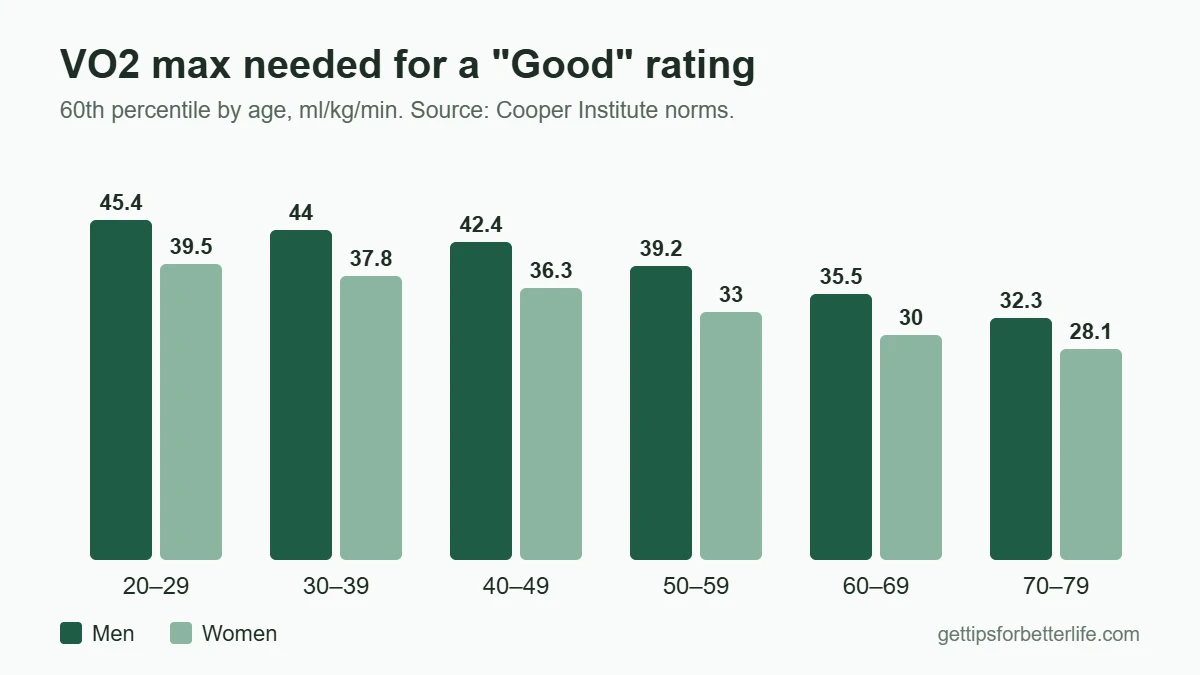
These ratings come from the Cooper Institute’s fitness norms. “Good” means you’re at or above the 60th percentile for your age and sex. “Poor” here means below the 40th percentile, so it covers a lot of ordinary people, not just the very unfit.
Men
| Age | Poor | Fair | Good | Excellent | Superior |
|---|---|---|---|---|---|
| 20–29 | below 41.7 | 41.7–45.3 | 45.4–51 | 51.1–55.3 | 55.4+ |
| 30–39 | below 40.5 | 40.5–43.9 | 44–48.2 | 48.3–53.9 | 54+ |
| 40–49 | below 38.5 | 38.5–42.3 | 42.4–46.3 | 46.4–52.4 | 52.5+ |
| 50–59 | below 35.6 | 35.6–39.1 | 39.2–43.3 | 43.4–48.8 | 48.9+ |
| 60–69 | below 32.3 | 32.3–35.4 | 35.5–39.4 | 39.5–45.6 | 45.7+ |
| 70–79 | below 29.4 | 29.4–32.2 | 32.3–36.6 | 36.7–42 | 42.1+ |
Women
| Age | Poor | Fair | Good | Excellent | Superior |
|---|---|---|---|---|---|
| 20–29 | below 36.1 | 36.1–39.4 | 39.5–43.8 | 43.9–49.5 | 49.6+ |
| 30–39 | below 34.4 | 34.4–37.7 | 37.8–42.3 | 42.4–47.3 | 47.4+ |
| 40–49 | below 33 | 33–36.2 | 36.3–39.6 | 39.7–45.2 | 45.3+ |
| 50–59 | below 30.1 | 30.1–32.9 | 33–36.6 | 36.7–41 | 41.1+ |
| 60–69 | below 27.5 | 27.5–29.9 | 30–32.9 | 33–37.7 | 37.8+ |
| 70–79 | below 25.9 | 25.9–28 | 28.1–30.8 | 30.9–36.6 | 36.7+ |
VO2 max drops with age for almost everyone. A 50-year-old man at 43 ml/kg/min rates Good to Excellent, while the same number at 25 is only Fair. That’s why the calculator asks for your age before it gives a rating.
Which test should you use?
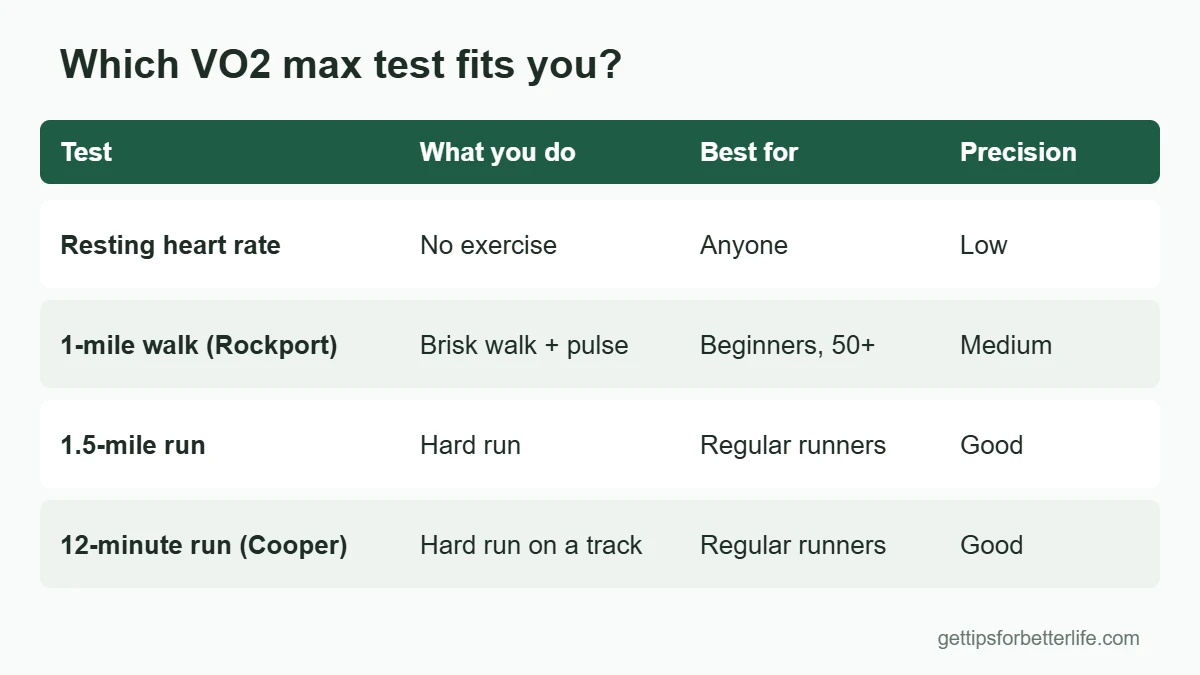
- Resting heart rate: no exercise needed, so anyone can do it. It’s also the least precise. It works best for people who train regularly.
- 1-mile walk (Rockport): good for beginners, older adults and anyone who can’t run. You need a heart rate monitor or a quick pulse count at the finish.
- 1.5-mile run: best if you can run the whole distance at a hard, steady pace. It’s the test the military has used for years.
- 12-minute run (Cooper): similar to the 1.5-mile run, but you run for a set time instead of a set distance. A running track makes the distance easy to measure.
If you have a heart condition, take blood pressure medicine or haven’t exercised in a while, check with your doctor before doing a maximal run or walk test.
How to do each test
Resting heart rate
Count your pulse for a full 60 seconds as soon as you wake up, before you sit up or have coffee. Do it on three mornings and use the average. If you know your real max heart rate from a hard effort, enter it. Otherwise the calculator estimates it as 208 minus 0.7 times your age.
1-mile walk (Rockport)
Warm up for a few minutes, then walk one mile on a flat route as fast as you can without jogging. Note your time and take your heart rate the moment you stop. A chest strap or watch is easiest. Otherwise count your pulse for 15 seconds and multiply by 4.
1.5-mile run
Six laps of a standard 400-meter track is just under 1.5 miles, so add about 14 meters to the last lap. Warm up, then run the distance as fast as you can hold. Pacing matters: starting too fast is the most common mistake.
12-minute run (Cooper)
Run, or run and walk, as far as you can in exactly 12 minutes, then measure the distance. On a 400-meter track, count laps and add the last partial lap. A GPS watch works too, but it can be off by a few percent.
How to improve your VO2 max
VO2 max responds to training at any age. Most of the gains come from two kinds of cardio:
- Easy, steady cardio for most of your weekly time, at a pace where you can still talk. Our zone 2 heart rate calculator shows the right range.
- Harder intervals once or twice a week, such as 3 to 5 minutes hard followed by easy recovery, repeated a few times. These push the top end.
The U.S. Physical Activity Guidelines recommend at least 150 minutes of moderate or 75 minutes of vigorous activity a week for adults. Retest every 6 to 8 weeks with the same method, on the same route, so the numbers are comparable.
Frequently asked questions
What is a good VO2 max?
It depends on your age and sex. For men in their 40s, about 42 ml/kg/min or higher is Good by Cooper Institute norms. For women in their 40s, it’s about 36 or higher. Use the chart above for your age group.
How accurate is a VO2 max calculator?
Field tests are estimates, so your result can differ from a lab test by a few points. The resting heart rate method is the least precise. They’re best for tracking your own progress over time with the same test, rather than comparing exact numbers with a lab report.
Is my smartwatch VO2 max accurate?
Watches estimate VO2 max from your heart rate and pace during runs or walks. They’re reasonable for trends but can be off by several points, especially if your max heart rate setting is wrong.
Can you increase VO2 max after 40?
Yes. Regular cardio raises VO2 max at any age, even though the average drops with each decade. Mixing easy steady sessions with some harder intervals tends to work best.
What VO2 max do you need for the Air Force PT test?
The Air Force scores the 2-mile run, not VO2 max directly. If you want to see how your run time scores, use our Air Force PT calculator.
Sources
- The Cooper Institute. VO2 max percentile norms by age and sex (as reprinted in Garmin’s VO2 max standard ratings, with permission from the Cooper Institute).
- Uth N, Sørensen H, Overgaard K, Pedersen PK. Estimation of VO2max from the ratio between HRmax and HRrest. Eur J Appl Physiol. 2004;91:111–115.
- Tanaka H, Monahan KD, Seals DR. Age-predicted maximal heart rate revisited. J Am Coll Cardiol. 2001;37(1):153–156.
- Cooper KH. A means of assessing maximal oxygen intake. JAMA. 1968;203(3):201–204.
- Kline GM, Porcari JP, Hintermeister R, et al. Estimation of VO2max from a one-mile track walk, gender, age, and body weight. Med Sci Sports Exerc. 1987;19(3):253–259.
- U.S. Department of Health and Human Services. Physical Activity Guidelines for Americans.
Related calculators
- Heart rate zone calculator: your five training zones.
- Zone 2 heart rate calculator: the easy aerobic range.
- Air Force PT calculator: score the 2-mile run and other events.