
Weight Loss Percentage Calculator
Enter your starting and current weight to see what percent of your body weight you’ve lost. Add a goal and the number of weeks to see your progress and weekly pace too.
Weight loss percentage calculator
Free, no sign-up. Nothing you type is saved.
Milestones from your starting weight
How to calculate weight loss percentage
Subtract your current weight from your starting weight, divide by your starting weight, then multiply by 100.
Weight loss % = (starting weight − current weight) ÷ starting weight × 100
Example: you started at 200 lb and now weigh 185 lb. That’s 15 lb lost. 15 ÷ 200 = 0.075, so you’ve lost 7.5% of your body weight.
It works the same in kilograms. Only the units change, never the percentage.
Percent lost vs percent of your goal
These are two different numbers, and the calculator shows both.
- Percent lost compares what you’ve lost with your starting weight. Losing 15 lb from 200 lb is 7.5%.
- Percent of goal compares what you’ve lost with what you set out to lose. If your goal is 170 lb (30 lb in total), losing 15 lb puts you 50% of the way there.
Percent lost is the number health guidelines use. Percent of goal is the one that tells you how far you have left.

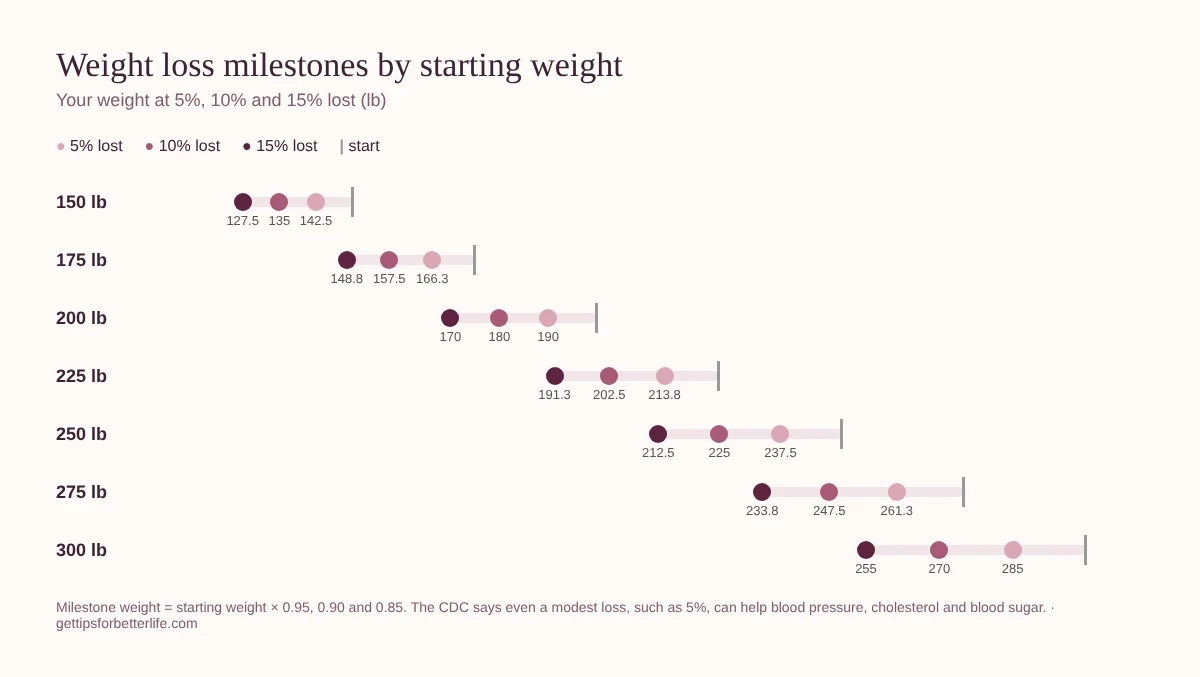
5%, 10% and 15% milestones by starting weight
| Starting weight | 5% lost (weight) | 10% lost (weight) | 15% lost (weight) |
|---|---|---|---|
| 150 lb | 7.5 lb (142.5) | 15 lb (135) | 22.5 lb (127.5) |
| 175 lb | 8.8 lb (166.3) | 17.5 lb (157.5) | 26.3 lb (148.8) |
| 200 lb | 10 lb (190) | 20 lb (180) | 30 lb (170) |
| 225 lb | 11.3 lb (213.8) | 22.5 lb (202.5) | 33.8 lb (191.3) |
| 250 lb | 12.5 lb (237.5) | 25 lb (225) | 37.5 lb (212.5) |
| 275 lb | 13.8 lb (261.3) | 27.5 lb (247.5) | 41.3 lb (233.8) |
| 300 lb | 15 lb (285) | 30 lb (270) | 45 lb (255) |
Why 5% and 10% matter
You don’t need to reach your “ideal” weight to see a benefit. The CDC says that even modest weight loss can help improve blood pressure, cholesterol and blood sugar levels, and could lower the risk of heart disease, prediabetes and type 2 diabetes. Its own example: a 5% loss for someone who weighs 200 pounds is 10 pounds.
That’s why the calculator marks 5% first, then 10%. They’re realistic targets that mean something for your health, not just the scale.
What’s a healthy pace?
The CDC says people who lose weight at a gradual, steady pace, about 1 to 2 pounds a week, are more likely to keep it off than people who lose it faster. Add “weeks since you started” in the calculator and it will tell you whether your average is slower than, within, or faster than that range.
Losing faster at the very start is common, partly because of water. If your pace stays well above 2 lb a week, it’s worth talking to your doctor.
To plan how long a goal might take, try our weight loss timeline calculator. To set a daily target, use the calorie deficit calculator.
Why the scale can move more slowly after 40
Midlife changes body composition, not just weight. In the SWAN study, which followed women through menopause, the rate of fat gain doubled at the start of the menopause transition and lean mass (mostly muscle) began to fall. Both trends continued until about two years after the final period, then levelled off.
Less muscle means fewer calories burned at rest, so the same habits can produce a slower drop on the scale. Two things help protect muscle while you lose fat: enough protein and regular strength training. See muscle loss after 40 and our protein calculator for women.
If you’re over 50 and wondering about timing, our guide on how long it takes to lose 20 pounds after 50 walks through realistic numbers.
Frequently asked questions
What is a good weight loss percentage?
Losing 5% of your starting weight is a meaningful first goal. The CDC uses 5% as its example of a modest loss that can help improve blood pressure, cholesterol and blood sugar.
How do I calculate weight loss percentage?
Take the pounds (or kilograms) you’ve lost, divide by your starting weight and multiply by 100. For example, 15 lb lost from 200 lb is 7.5%.
How much is 5% of my body weight?
Multiply your starting weight by 0.05. At 180 lb that’s 9 lb, and at 250 lb it’s 12.5 lb. The table above shows more starting weights.
Is losing 2 pounds a week too fast?
No. Up to 2 lb a week is within the gradual 1 to 2 lb range the CDC describes. A faster pace for a week or two at the start is common, but if it continues, check with your doctor.
Does this calculator work in kilograms?
Yes. Switch to kg and any weights you’ve entered convert automatically. The percentage is the same in either unit.
More weight tools
- Weight loss timeline calculator
- Calorie deficit calculator
- BMI calculator for women
- Walking calorie calculator
This calculator is for general information only and isn’t medical advice. Talk to your doctor before starting a weight loss plan, especially if you have a health condition.
Last updated: 6 November 2026
Sources
- Centers for Disease Control and Prevention. Steps for losing weight. Updated January 17, 2025. https://www.cdc.gov/healthy-weight-growth/losing-weight/index.html
- Greendale GA, Sternfeld B, Huang M, et al. Changes in body composition and weight during the menopause transition. JCI Insight. 2019;4(5):e124865. https://pubmed.ncbi.nlm.nih.gov/30843880/