Can You Build Muscle in a Calorie Deficit? (Yes, Here’s How)
Quick answer: Yes, especially if you’re new to strength training, returning after a break, or carrying extra body fat. This is called body recomposition: losing fat and gaining muscle at the same time. It works best with a modest deficit, plenty of protein and regular strength training.
Try it yourself: A 160 lb (73 kg) woman aiming for 1.2 to 1.6 g of protein per kg needs about 87 to 116 g of protein a day, or roughly 30 to 39 g per meal over 3 meals. Check yours in the protein calculator.
Who Can Build Muscle While Losing Fat?
| You’re more likely to build muscle in a deficit if you… | It’s harder if you… |
|---|---|
| Are new to lifting or returning after time off | Have lifted consistently for years |
| Have more body fat to lose | Are already very lean |
| Eat enough protein every day | Eat little protein |
| Keep the deficit modest | Cut calories very hard |
| Sleep reasonably well | Sleep very little |
Many women over 40 fit the left column, which is good news.
How Big Should the Deficit Be?
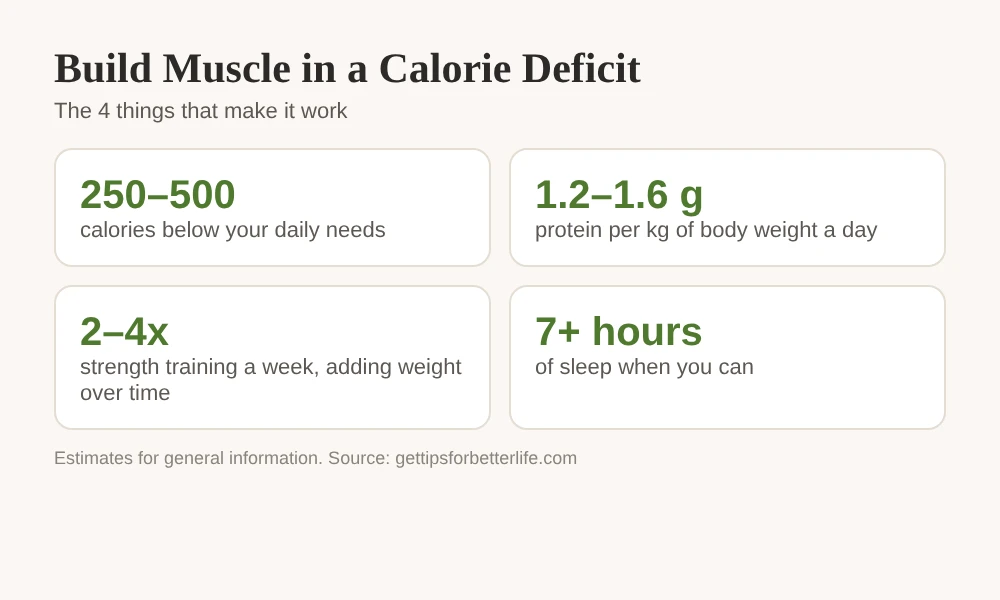
Keep it modest: about 250 to 500 calories below your daily needs. A very large deficit makes muscle gain much harder and raises the risk of losing muscle. Find your target with the calorie deficit calculator, and don’t go below about 1,200 calories a day without medical guidance.
How Much Protein Do You Need?
Protein is the most important part. Research on people doing strength training found muscle gains leveled off at about 1.6 g of protein per kg of body weight a day. For many women over 40, 1.2 to 1.6 g per kg is a practical range, spread across meals:
- about 25 to 30 g per meal, 3 times a day
- see protein per meal for women over 50 for food examples
Check your number with the protein calculator for women.
How to Train
- Lift 2 to 4 times a week, working all major muscle groups (legs, back, chest, shoulders, arms, core).
- Use progressive overload: slowly add weight, reps or sets over time.
- Choose compound moves: squats or sit-to-stands, lunges, rows, presses, deadlift-style hip hinges.
- Stop 1 to 3 reps short of failure on most sets, with good form.
- Keep walking. Daily steps help the deficit without hurting recovery.
Why It Matters More After 40
Women tend to lose muscle with age, and the menopause transition speeds up changes in body composition. Muscle helps with strength, balance, blood sugar and daily energy. Losing weight without strength training can mean losing a lot of muscle along with fat. See how much lean mass you have with the lean body mass calculator.
How to Tell It’s Working
The scale may barely move when you gain muscle and lose fat. Track these instead:
- Waist size going down (use the waist-to-hip ratio calculator)
- Strength going up in your lifts
- Clothes fitting differently
- Body fat % trending down over a few months (see the body fat calculator)
Frequently Asked Questions
Can women build muscle in a calorie deficit?
Yes. Women new to strength training often gain muscle while losing fat, as long as they eat enough protein and train regularly.
How long does body recomposition take?
Most people notice changes in strength within a few weeks, and visible changes in 2 to 3 months.
Should I eat at maintenance instead?
If you mainly want muscle and aren’t trying to lose fat, eating at maintenance or a small surplus makes muscle gain easier.
Do I need protein shakes?
No. Food works fine. Shakes are just a convenient option if you struggle to reach your protein target.
Is it better to lose fat first or build muscle first?
If you have weight to lose and are new to lifting, you can do both at once. Keep the deficit modest and protein high.
Can you build muscle after 50?
Yes. Studies of older adults show strength training builds muscle and strength at any age, especially with enough protein.
Related Tools
This article is for general information only and is not medical advice. Check with your doctor before starting a new exercise program if you have a health condition. Read our Medical Disclaimer.
Sources
- Morton RW, et al. A systematic review, meta-analysis and meta-regression of the effect of protein supplementation on resistance training-induced gains in muscle mass and strength. Br J Sports Med. 2018 — https://pubmed.ncbi.nlm.nih.gov/28698222/
- Barakat C, et al. Body recomposition: can trained individuals build muscle and lose fat at the same time? Strength Cond J. 2020
- Greendale GA, et al. Changes in body composition and weight during the menopause transition (SWAN). JCI Insight. 2019 — https://pubmed.ncbi.nlm.nih.gov/30843880/
- U.S. HHS. Physical Activity Guidelines for Americans, 2nd edition — https://health.gov/our-work/nutrition-physical-activity/physical-activity-guidelines
Keep reading
More evidence-based guides for staying strong after 40.