Does Salt Break a Fast? (Pinch of Salt, Sole Water & Ketosis)
Quick answer: No. Salt has zero calories and no carbs, protein or fat, so a pinch of salt in water won’t break an intermittent fast or kick you out of ketosis. The real limit is sodium, not calories: 1 teaspoon of salt has about 2,300 mg of sodium, the full daily limit for adults. Before a fasting blood test, skip it and drink plain water only.
Try it yourself: On a 16:8 plan with meals from 11 AM to 7 PM, a pinch of salt in a glass of water at 9 AM adds 0 calories, so your fast continues. If you’re salting water often, count that sodium toward your daily total. Plan your fasting hours in the intermittent fasting calculator.
How Much Sodium Is in Salt?
Table salt is about 40% sodium by weight. USDA FoodData Central lists table salt at 0 calories and about 38,760 mg of sodium per 100 g.
| Amount of salt | Calories | Sodium | Breaks an intermittent fast? |
|---|---|---|---|
| A pinch (1/16 to 1/8 teaspoon) | 0 | roughly 145 to 290 mg | No |
| 1/4 teaspoon | 0 | about 575 mg | No |
| 1/2 teaspoon | 0 | about 1,150 mg | No, but that’s half a day’s sodium |
| 1 teaspoon | 0 | about 2,300 mg | No, but that’s a full day’s sodium |
Sodium amounts for 1/4, 1/2 and 1 teaspoon are from the American Heart Association. The pinch range is calculated from those figures, since a “pinch” isn’t a standard measure.
Because salt has no calories, it sits in the same “doesn’t count” group as water and close to black coffee. For the general rule, see how many calories break a fast.
Does Salt Break a Fast? It Depends on Your Goal
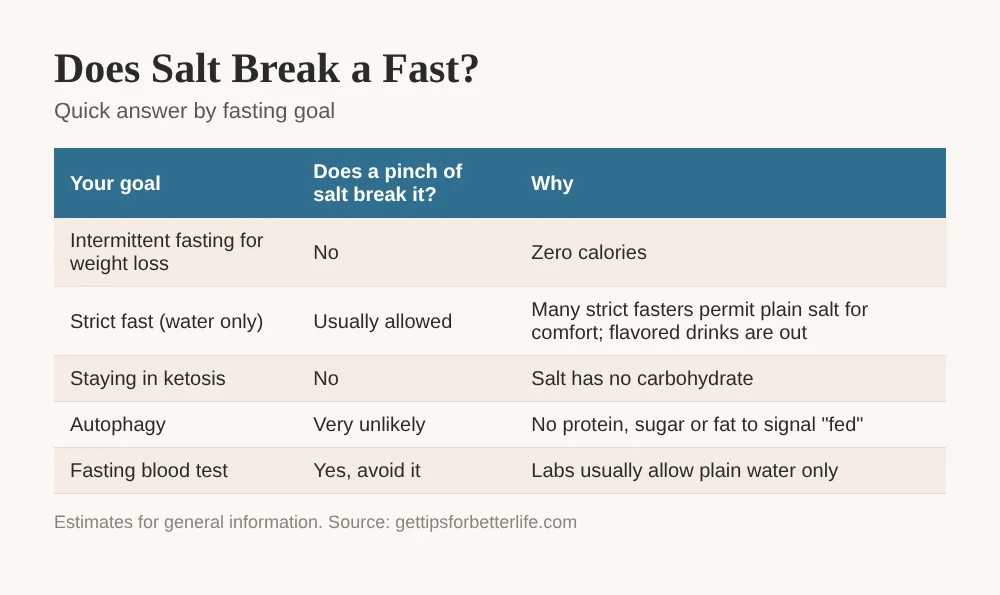
| Your goal | Does a pinch of salt break it? | Why |
|---|---|---|
| Intermittent fasting for weight loss | No | Zero calories |
| Strict fast (water only) | Usually allowed | Many strict fasters permit plain salt for comfort; flavored drinks are out |
| Staying in ketosis | No | Salt has no carbohydrate |
| Autophagy | Very unlikely | No protein, sugar or fat to signal “fed” |
| Fasting blood test | Yes, avoid it | Labs usually allow plain water only |
Weight-loss intermittent fasting. A pinch of salt is fine. Some people find it eases the light-headed or headachy feeling that can come with the first weeks of fasting, especially on hot days or after exercise.
Ketosis. Salt contains no carbs, so it can’t raise blood sugar or stop ketone production. Salted drinks with added sugar are a different matter.
Autophagy. No study has tested salt and autophagy in people. Since salt supplies no nutrients that switch on growth signals, there’s no clear reason it would interfere, but that is an assumption, not a finding.
Fasting blood tests. MedlinePlus says to have nothing but plain water for the 8 to 12 hours before most fasting tests. Add salt back after your blood draw.
What About Sole Water?
Sole (pronounced “so-lay”) water is made by dissolving salt in water until no more will dissolve, then stirring a spoonful of that brine into a glass of water. It has no calories, so it won’t break a fast. Keep in mind that it’s very concentrated, so a single teaspoon of the brine can add a meaningful amount of sodium. There’s no research showing sole water has special benefits beyond the salt itself.
Is Pink Salt Better for Fasting?
Not in any meaningful way. Pink salt is still mostly sodium chloride. An Australian study tested 31 pink salt samples and found that a person would need to eat more than 30 g a day (about 6 teaspoons) to get a useful amount of the extra minerals, a dose that would supply far too much sodium. One sample also contained lead above the national safety limit (Fayet-Moore et al., 2020).
The American Heart Association says table salt and most sea salts contain about the same sodium by weight. A teaspoon of coarse salt may hold slightly less simply because larger crystals pack less tightly. Pick whatever salt you like the taste of, and measure it the same way.
Salt, Fasting and Women Over 40
- Know your limit. Adults should stay under 2,300 mg of sodium a day, and the American Heart Association suggests an ideal of 1,500 mg for most adults. A quarter-teaspoon of salt in morning water uses up about a quarter of the higher limit before any food.
- Blood pressure changes with menopause. Mayo Clinic notes that blood pressure tends to rise after menopause and that hormonal changes can make it more sensitive to salt. If you have high blood pressure, heart failure or kidney disease, ask your doctor before adding salt during fasts.
- Watch for hidden sodium. Electrolyte packets, broth and pickle juice all add up. See do electrolytes break a fast and does bone broth break a fast.
If fasting isn’t moving the scale in perimenopause, salt isn’t the issue either way. Read why intermittent fasting may not be working in menopause.
Frequently Asked Questions
Can I have salt while intermittent fasting?
Yes. Salt has zero calories, so it won’t break an intermittent fast. Just count it toward your daily sodium.
Does salt break ketosis?
No. Salt contains no carbohydrate and doesn’t affect ketone production.
Will a pinch of salt in water break my fast?
No. A pinch adds no calories and roughly 145 to 290 mg of sodium, depending on how big your pinch is.
What can you drink while fasting?
Water, plain sparkling water, black coffee, plain tea such as green tea, and water with a pinch of salt. Many people also use lemon water or diet soda during weight-loss fasting.
Does pink Himalayan salt break a fast?
No. Like table salt, it has no calories. Its extra minerals are present in amounts too small to matter.
How much salt is too much during a fast?
Anything that pushes you over 2,300 mg of sodium for the day, counting food. That’s about 1 teaspoon of salt in total.
Related Tools
- Intermittent Fasting Calculator
- Do Electrolytes Break a Fast?
- Does Collagen Break a Fast?
- Does Apple Cider Vinegar Break a Fast?
This article is for general information only and is not medical advice. Read our Medical Disclaimer.
Sources
American Heart Association: Salt vs. Sodium; Sea Salt vs. Table Salt — https://sodiumbreakup.heart.org/salt-vs-sodium2 and https://sodiumbreakup.heart.org/sea_salt_vs_table_salt
USDA FoodData Central: Salt, table (FDC ID 173468) — https://fdc.nal.usda.gov/
Fayet-Moore F, et al. An Analysis of the Mineral Composition of Pink Salt Available in Australia. Foods. 2020;9(10):1490 — https://doi.org/10.3390/foods9101490
Mayo Clinic: Menopause and high blood pressure: What’s the connection? — https://www.mayoclinic.org/diseases-conditions/high-blood-pressure/expert-answers/menopause-and-high-blood-pressure/faq-20058406
MedlinePlus (NIH): Fasting for a Blood Test — https://medlineplus.gov/lab-tests/fasting-for-a-blood-test
Keep reading
More evidence-based guides for staying strong after 40.