Does Bone Broth Break a Fast? (By Fasting Goal)
Quick answer: Yes, technically. A cup of bone broth has roughly 40 calories and 9 grams of protein, so it ends a strict zero-calorie fast. For intermittent fasting for weight loss, a single cup is a small amount of food, and some people use it to get through a long or hard fasting day. It is still food, though, so many people simply count it as the start of their eating window. Before a fasting blood test, skip it and follow your lab’s instructions.
Try it yourself: On a 16:8 plan with meals from noon to 8 PM, a cup of bone broth at 9 AM technically starts your eating window 3 hours early. If you want to keep a full 16-hour fast, have the broth at noon as your first meal instead. Plan your hours in the intermittent fasting calculator.
Calories and Protein in Bone Broth vs. Regular Broth
Bone broth is simmered much longer than regular broth, so it pulls more protein (mostly from collagen) out of the bones. That is also why it has more calories.
| Broth (1 cup) | Calories | Protein | Carbs | Sodium |
|---|---|---|---|---|
| Chicken bone broth, packaged | 40 | 9 g | 0 g | 560 mg |
| Chicken broth, ready-to-serve | 15 | about 2 g | about 1 g | 920 mg |
| Beef broth or bouillon, ready-to-serve | 15 | about 3 g | 0 g | 890 mg |
| Water, black coffee or plain tea, for comparison | 0 to 2 | 0 g | 0 g | Trace |
Values from USDA FoodData Central. Brands vary a lot, especially for sodium, so check the label on yours.
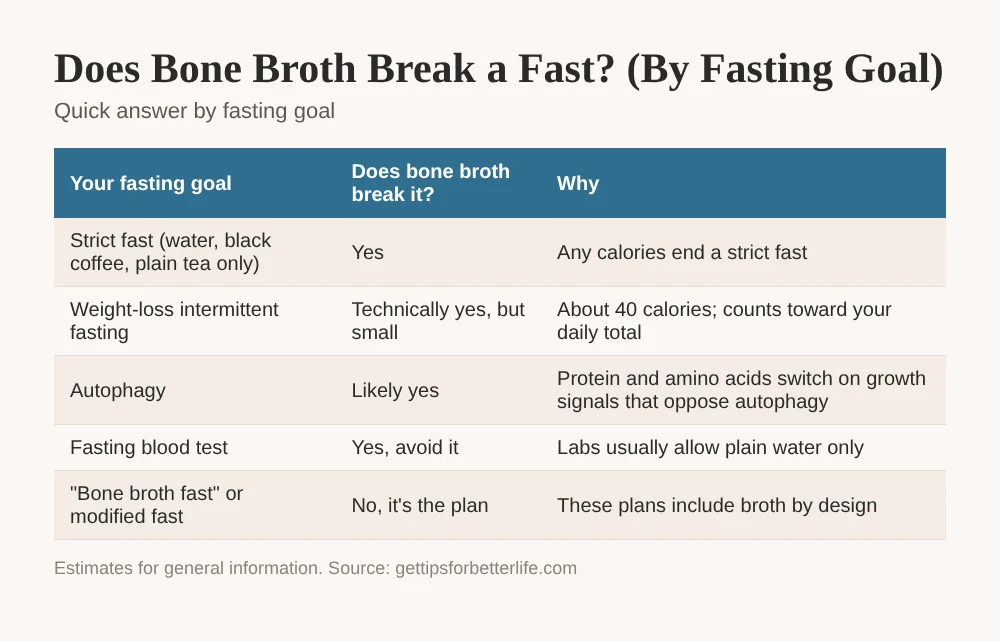
Does It Break a Fast? It Depends on Your Goal
| Your fasting goal | Does bone broth break it? | Why |
|---|---|---|
| Strict fast (water, black coffee, plain tea only) | Yes | Any calories end a strict fast |
| Weight-loss intermittent fasting | Technically yes, but small | About 40 calories; counts toward your daily total |
| Autophagy | Likely yes | Protein and amino acids switch on growth signals that oppose autophagy |
| Fasting blood test | Yes, avoid it | Labs usually allow plain water only |
| Bone broth fast or modified fast | No, it is the plan | These plans include broth by design |
Weight-loss intermittent fasting. Fat loss mostly comes down to eating less over the week. A 40-calorie cup is not going to undo that, and if it stops you from raiding the pantry at 10 AM, it may help. The tradeoff is that you are no longer truly fasting during those hours, so it is cleaner to count the broth as your first meal. See how many calories break a fast.
Strict fast. Zero calories means zero calories. Broth is out until your window opens.
Autophagy. In lab research, amino acids (the building blocks of protein) activate a cell-growth switch called mTOR, which turns autophagy down. That makes a protein-rich drink like bone broth a poor fit if autophagy is your main goal. Keep in mind that most autophagy research is in cells and animals, there is no simple way to measure it in people, and no human study has tested bone broth specifically.
Fasting blood tests. Cleveland Clinic advises 8 to 12 hours of fasting with plain water only for most fasting blood work. Broth, coffee and flavored water are all out. Follow the instructions from your own doctor or lab.
Is Bone Broth a Good Way to Break a Fast?
It can be. Bone broth is warm, low in calories and easy on the stomach for many people, which makes it a gentle first item after a long fast. Just do not let it replace a real meal. With about 9 grams of protein, a cup is a starter, not a full serving of protein.
Bone Broth, Fasting and Women Over 40
- Protein matters more with age. Muscle loss speeds up as women get older, and fasting can make it harder to fit enough protein into fewer meals. An expert group (PROT-AGE) recommends that adults over 65 aim for at least 1.0 to 1.2 grams of protein per kilogram of body weight per day. Bone broth can help a little, but its protein is mostly collagen, which is not a complete protein. Build your meals around eggs, dairy, fish, poultry, beans or tofu, and add broth on top.
- Watch the sodium. The Dietary Guidelines for Americans suggest staying under 2,300 mg of sodium a day. Some broths have 900 mg or more per cup, so two or three cups can use up most of that. If you are watching your blood pressure, choose a low-sodium version.
- If intermittent fasting has stalled, small calorie sources like broth, creamer and snacks during the fasting hours are worth checking. Read why intermittent fasting may not be working in menopause and estimate your target with the calorie deficit calculator.
Frequently Asked Questions
Can I drink bone broth while intermittent fasting?
Yes, if your goal is weight loss and a cup helps you stick to your plan. Just know that it technically ends the fast. Strict fasters and anyone fasting for autophagy usually wait until their eating window.
Does bone broth break autophagy?
Probably. It contains protein, and amino acids are known to switch on mTOR, which slows autophagy in lab studies. There is no human research on bone broth and autophagy.
How many calories are in a cup of bone broth?
About 40 for many packaged chicken bone broths, with roughly 9 grams of protein. Homemade broth varies with how long it is simmered and how much fat is left in.
Does chicken broth break a fast?
Regular chicken broth has about 15 calories a cup, so it technically breaks a strict fast but is very light. Its sodium is often higher than bone broth’s.
Will bone broth kick me out of ketosis?
Unlikely. Most bone broths have 0 to 1 gram of carbs per cup. Ketosis and fasting are not the same thing, though: you can stay in ketosis and still have ended your fast.
What else breaks a fast?
Anything with meaningful calories, including milk, juice and most supplements made with oil. See does MCT oil break a fast, does creatine break a fast and does black coffee break a fast.
Related Tools
- Intermittent Fasting Calculator
- Calorie Deficit Calculator
- Does Apple Cider Vinegar Break a Fast?
- Does Green Tea Break a Fast?
This article is for general information only and is not medical advice. Read our Medical Disclaimer.
Sources
- USDA FoodData Central: Chicken Organic Bone Broth (FDC ID 2656706); Soup, chicken broth, ready-to-serve (FDC ID 174536); Soup, beef broth or bouillon, canned, ready-to-serve (FDC ID 171538) — https://fdc.nal.usda.gov/
- Bauer J, et al. Evidence-based recommendations for optimal dietary protein intake in older people: a position paper from the PROT-AGE Study Group. J Am Med Dir Assoc. 2013 — https://doi.org/10.1016/j.jamda.2013.05.021
- Liu C, et al. Functional Amino Acids and Autophagy: Diverse Signal Transduction and Application. Int J Mol Sci. 2021 — https://pmc.ncbi.nlm.nih.gov/articles/PMC8592284/
- Cleveland Clinic: Fasting for Blood Work — https://my.clevelandclinic.org/health/articles/fasting-for-blood-work
- U.S. Departments of Agriculture and Health and Human Services: Dietary Guidelines for Americans (sodium limit) — https://www.dietaryguidelines.gov/
Keep reading
More evidence-based guides for staying strong after 40.