Do Electrolytes Break a Fast? (By Fasting Goal)
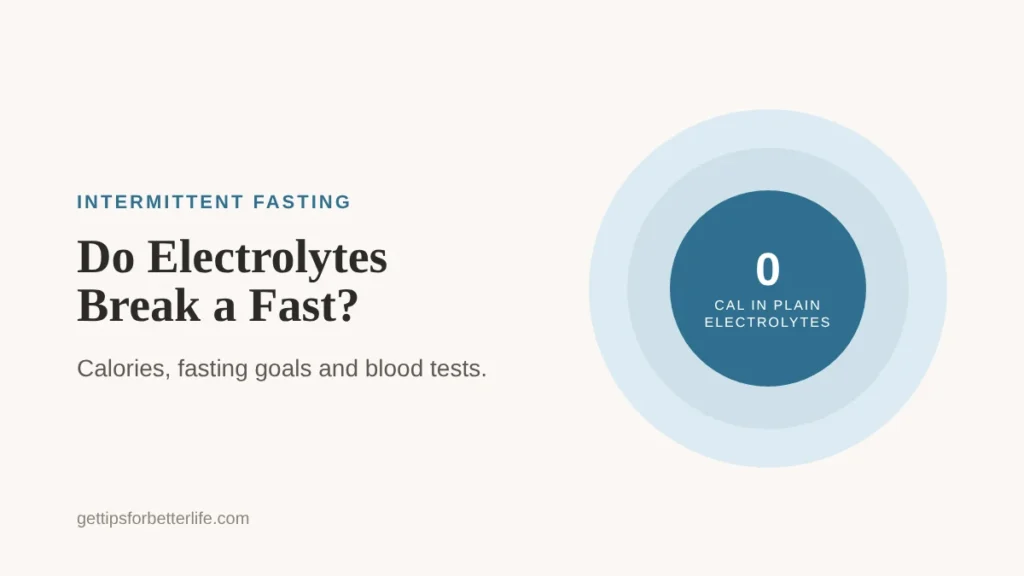
Quick answer: No, as long as they’re plain. Sodium, potassium and magnesium are minerals with zero calories, so a pinch of salt in water or an unsweetened electrolyte mix won’t end an intermittent fast. What does break a fast is what often comes with them: sugar. A cup of a ready-to-drink sports drink has about 77 calories and 15 g of sugar, and a cup of unsweetened coconut water has about 43 calories and 9 g of sugar. Before a fasting blood test, skip electrolytes and drink plain water only.
Try it yourself: On a 16:8 plan with meals from noon to 8 PM, a glass of water with a zero-sugar electrolyte mix at 9 AM keeps your fast going. A sugary sports drink at the same time would start your eating window 3 hours early. Map out your hours in the intermittent fasting calculator.
Which Electrolyte Drinks Break a Fast?
Values for coconut water and sports drinks are calculated from USDA FoodData Central (1 cup = 240 g). Drink mixes vary by brand, so always read the label.
| Electrolyte option (1 serving) | Calories | Sugar | Breaks an intermittent fast? |
|---|---|---|---|
| Water with a pinch of salt | 0 | 0 g | No |
| Magnesium or potassium tablets (no sugar coating) | 0 | 0 g | No |
| Zero-sugar electrolyte packet | 0 to about 10 | 0 g | No for weight loss; check for sweeteners |
| Unsweetened coconut water, 1 cup | about 43 | about 9 g | Yes |
| Ready-to-drink sports drink, 1 cup | about 77 | about 15 g | Yes |
The minerals themselves are never the problem. Sugar, juice powders and maltodextrin are. Many zero-sugar packets use stevia or other sweeteners instead; see does stevia break a fast if that matters for your plan, and how many calories break a fast for the bigger picture.
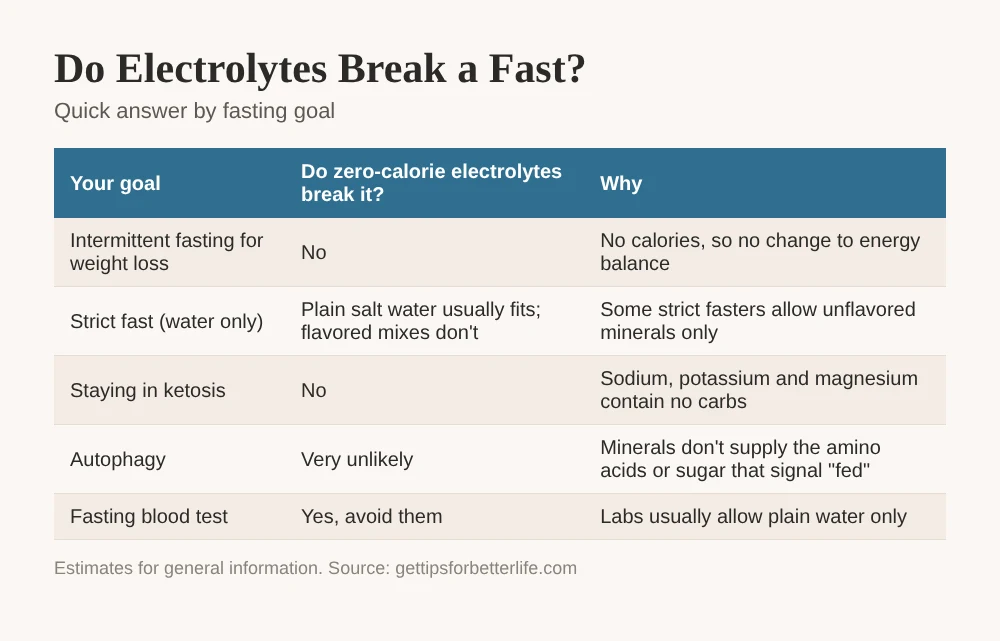
Do Electrolytes Break a Fast? It Depends on Your Goal
| Your goal | Do zero-calorie electrolytes break it? | Why |
|---|---|---|
| Intermittent fasting for weight loss | No | No calories, so no change to energy balance |
| Strict fast (water only) | Plain salt water usually fits; flavored mixes don’t | Some strict fasters allow unflavored minerals only |
| Staying in ketosis | No | Sodium, potassium and magnesium contain no carbs |
| Autophagy | Very unlikely | Minerals don’t supply the amino acids or sugar that signal “fed” |
| Fasting blood test | Yes, avoid them | Labs usually allow plain water only |
Weight-loss intermittent fasting. Zero-calorie electrolytes are fine. If a packet lists 5 to 10 calories from flavoring, that’s still far too little to matter for most 14:10 or 16:8 plans.
Ketosis. Minerals carry no carbohydrate. Sugary sports drinks and coconut water do, and a full bottle can add enough sugar to matter on a very low-carb plan.
Autophagy. There’s no human research testing electrolytes and autophagy. Because plain minerals provide no protein or sugar, there’s no clear reason to expect them to interfere, but that remains an assumption.
Fasting blood tests. MedlinePlus says to drink only plain water for the 8 to 12 hours before a fasting test, and to tell your provider about any supplements you take. Electrolyte packets and magnesium pills can wait until after the blood draw.
How Much Sodium, Potassium and Magnesium Do Women Need?
| Mineral | Daily target for women 40+ | Useful to know |
|---|---|---|
| Sodium | 1,500 mg adequate intake; keep it under 2,300 mg | 1/4 teaspoon of salt has about 575 mg |
| Potassium | 2,600 mg adequate intake | Many supplements stop at 99 mg per serving |
| Magnesium | 320 mg recommended | Supplements shouldn’t exceed 350 mg a day unless a doctor advises it |
Sources: National Academies (sodium), NIH Office of Dietary Supplements (potassium, magnesium), American Heart Association (salt conversion).
Some zero-sugar packets contain up to about 1,000 mg of sodium per serving (check the label), which is close to half of the 2,300 mg daily limit in one drink. That may suit a heavy sweater on a hot day, but it’s a lot for someone sitting at a desk.
When Do You Actually Need Electrolytes While Fasting?
Most people doing a 12- to 16-hour daily fast don’t need anything extra. Regular meals inside the eating window usually cover sodium, potassium and magnesium. Electrolytes are more likely to help:
- On longer fasts of 24 hours or more, when no food is coming in to replace minerals.
- In hot weather or when you sweat a lot.
- Around long or hard workouts done in a fasted state.
- If you feel headachy, dizzy or wiped out during a fast. A pinch of salt in water is a simple first step, but those symptoms are also a reason to eat and check in with a doctor if they keep happening.
Electrolytes, Fasting and Women Over 40
- Blood pressure. Blood pressure tends to rise after menopause, and hormonal changes can make it more sensitive to salt (more on this in does salt break a fast). High-sodium packets every day can quietly push you over the limit.
- Kidney disease. The NIH Office of Dietary Supplements warns that people with chronic kidney disease can develop high potassium even from intakes below the normal target, and that magnesium toxicity risk rises when the kidneys don’t work well. Get medical advice before using any electrolyte product.
- Blood pressure medicines. ACE inhibitors, ARBs and potassium-sparing diuretics reduce how much potassium the body gets rid of, so extra potassium can build up. Loop and thiazide diuretics can drain magnesium. Ask your pharmacist before adding a potassium or magnesium supplement.
- Bone medicines and antibiotics. Magnesium can reduce absorption of osteoporosis drugs such as alendronate and of some antibiotics, so the timing needs to be spaced out.
If your fasting plan has stalled in perimenopause, electrolytes won’t fix it. See why intermittent fasting may not be working in menopause.
Frequently Asked Questions
Can I have electrolytes while fasting?
Yes. Plain or zero-sugar electrolytes have no meaningful calories and won’t break an intermittent fast for weight loss. Avoid versions with added sugar.
Will magnesium break a fast?
No. Magnesium has no calories. Plain capsules or tablets are fine during a fasting window, though supplement doses can cause diarrhea, nausea or cramping (forms such as magnesium oxide and chloride are common culprits), which is harder to deal with on an empty stomach. Gummies usually contain sugar.
Do electrolyte packets break a fast?
Zero-sugar packets don’t for weight-loss fasting. Packets with sugar or maltodextrin do. Check the nutrition label for calories and total sugars.
Does coconut water break a fast?
Yes. A cup has about 43 calories and 9 g of sugar, along with roughly 400 mg of potassium.
Do I need electrolytes for a 16:8 fast?
Usually not. Your meals typically supply enough. They’re more useful for fasts longer than 24 hours, heat and heavy exercise.
Does salt water break a fast?
No. Salt has zero calories. See does salt break a fast for safe amounts.
Related Tools
- Intermittent Fasting Calculator
- Does Salt Break a Fast?
- Does Collagen Break a Fast?
- Does Black Coffee Break a Fast?
This article is for general information only and is not medical advice. Read our Medical Disclaimer.
Sources
NIH Office of Dietary Supplements: Potassium Fact Sheet for Health Professionals — https://ods.od.nih.gov/factsheets/Potassium-HealthProfessional/
NIH Office of Dietary Supplements: Magnesium Fact Sheet for Health Professionals — https://ods.od.nih.gov/factsheets/Magnesium-HealthProfessional/
National Academies of Sciences, Engineering, and Medicine: Sodium and Potassium Dietary Reference Intake Values Updated in New Report (2019) — https://www.nationalacademies.org/news/sodium-and-potassium-dietary-reference-intake-values-updated-in-new-report
USDA FoodData Central: Beverages, coconut water, ready-to-drink, unsweetened (FDC ID 174831); Beverages, lemon-lime sports drink, ready-to-drink (FDC ID 175108) — https://fdc.nal.usda.gov/
MedlinePlus (NIH): Fasting for a Blood Test — https://medlineplus.gov/lab-tests/fasting-for-a-blood-test
Keep reading
More evidence-based guides for staying strong after 40.