Does Green Tea Break a Fast? (Plus Black, Herbal and Tea With Milk)
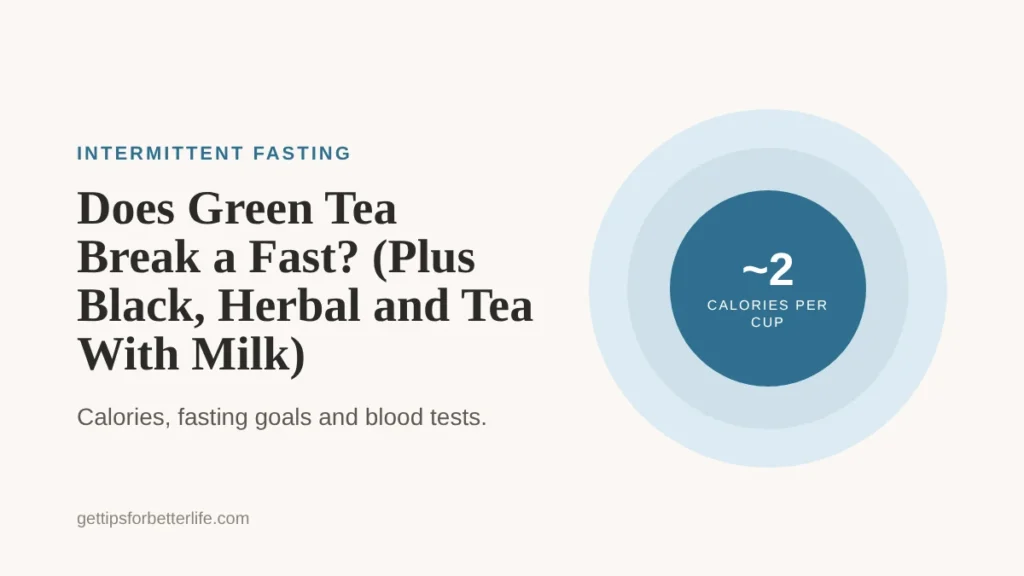
Quick answer: No. A cup of plain brewed green tea has about 2 calories and no carbs, so it doesn’t break an intermittent fast. The same goes for plain black tea and herbal tea. Adding milk, sugar or honey adds calories and technically ends the fast. Before a fasting blood test, follow your lab’s instructions, which usually allow plain water only.
Try it yourself: On a 16:8 schedule with meals from 10 AM to 6 PM, green tea at 7 AM fits your fasting window. A cup of tea with 2 tablespoons of whole milk adds about 18 calories; a tablespoon of half-and-half adds about 20. Set up your window in the intermittent fasting calculator.
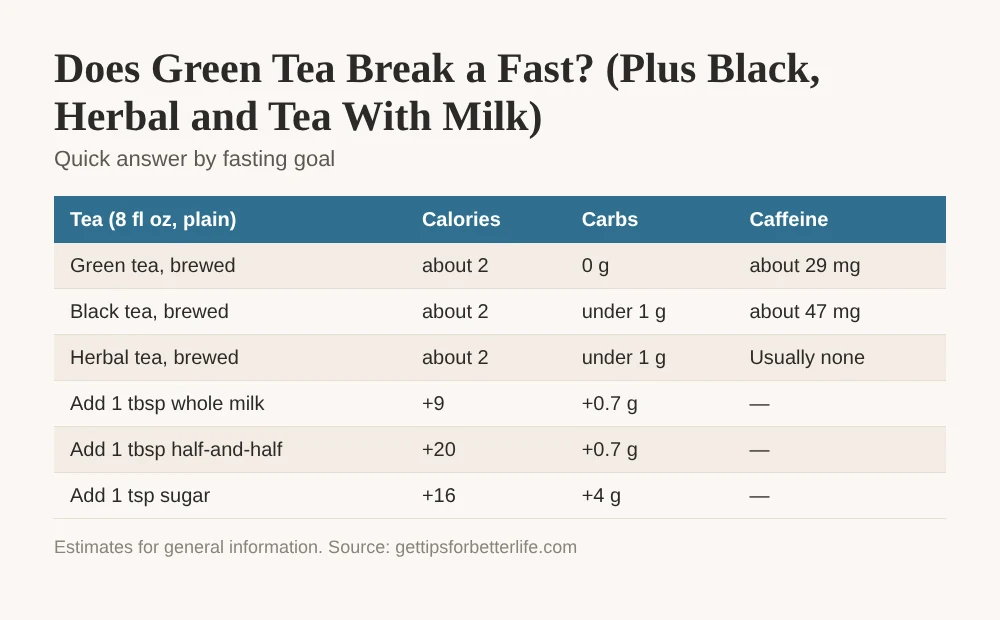
Calories and Caffeine in Tea (8 oz Cup)
| Tea (8 fl oz, plain) | Calories | Carbs | Caffeine |
|---|---|---|---|
| Green tea, brewed | about 2 | 0 g | about 29 mg |
| Black tea, brewed | about 2 | under 1 g | about 47 mg |
| Herbal tea, brewed | about 2 | under 1 g | Usually none |
| Add 1 tbsp whole milk | +9 | +0.7 g | — |
| Add 1 tbsp half-and-half | +20 | +0.7 g | — |
| Add 1 tsp sugar | +16 | +4 g | — |
Values from USDA FoodData Central. Brewing time and tea brand change the caffeine amount.
Does Tea Break a Fast? It Depends on Your Goal
| Drink | Strict (zero-calorie) fast | Weight-loss intermittent fasting | Fasting blood test |
|---|---|---|---|
| Plain green tea | Usually allowed | No | Follow lab rules (usually water only) |
| Plain black tea | Usually allowed | No | Follow lab rules (usually water only) |
| Plain herbal tea | Usually allowed | No | Follow lab rules (usually water only) |
| Tea with a splash of milk | Yes | Technically yes, but small | Yes, avoid |
| Tea with sugar or honey | Yes | Yes | Yes, avoid |
| Matcha or chai latte | Yes | Yes | Yes, avoid |
| Bottled sweetened tea | Yes | Yes | Yes, avoid |
Weight-loss intermittent fasting. Plain tea is one of the easiest things to drink during your fasting hours. It has almost no calories and can make the morning feel less empty. If you can’t drink it without milk, a small splash is a minor amount, but a latte is a snack.
Strict fast. Most people who follow a strict fast still allow plain water, black coffee and plain tea, since they have only trace calories. If your plan is water only, that rules out tea too.
Autophagy. Plain tea adds almost no calories or protein, so it isn’t expected to interfere much. That said, most fasting and autophagy research comes from cell and animal studies, and there’s no easy way to measure autophagy in people. Milk adds protein, which is a better reason to skip it if autophagy is your goal.
Fasting blood tests. Fasting for blood work usually means 8 to 12 hours with plain water only, and many labs specifically rule out coffee, even black. Treat tea the same way unless your doctor or lab says otherwise.
Does Green Tea Help With Fasting or Weight Loss?
Green tea contains caffeine and catechins such as EGCG, and you’ll often see it sold as a fat burner. The effect of brewed tea on weight is small at best. It’s a helpful fasting drink because it’s nearly calorie-free and can take the edge off hunger for some people, not because it melts fat.
Be more careful with green tea extract supplements. Europe’s food safety agency (EFSA) found that 800 mg or more of EGCG a day from supplements was linked with a rise in liver enzymes, a sign of liver stress. Brewed tea typically provides far less, about 90 to 300 mg of EGCG a day for regular drinkers, and is generally considered safe. EFSA also noted that taking catechins on an empty stomach raises the amount that reaches the blood, which matters if you’re fasting.
Tea, Fasting and Women Over 40
- Caffeine and sleep. Sleep is often more fragile in perimenopause. In one study, 400 mg of caffeine taken 6 hours before bed cut sleep by more than an hour. That’s a lot more caffeine than a cup of tea, but it shows how long caffeine lingers. If your fasting window runs into the evening, switch to herbal or decaf tea after lunch.
- Caffeine and hot flashes. A Mayo Clinic study found caffeine was linked with more bothersome hot flashes and night sweats in postmenopausal women. Green tea has less caffeine than coffee, but if hot flashes are a problem, try caffeine-free herbal tea for a few weeks and see if it helps.
- Daily limit. The FDA says up to about 400 mg of caffeine a day is generally not linked with negative effects in healthy adults. Count tea along with coffee and soda.
If intermittent fasting has stalled, read why intermittent fasting may not be working in menopause.
Frequently Asked Questions
Does tea with milk break a fast?
Technically, yes. A tablespoon of whole milk adds about 9 calories. For weight-loss fasting, a small splash is minor; for a strict fast, skip it.
Does herbal tea break a fast?
No. Plain herbal teas such as peppermint, chamomile or rooibos have about 2 calories a cup and no caffeine. Avoid blends with added fruit pieces, sugar or honey.
Does matcha break a fast?
Plain matcha whisked with water is very low in calories and fits most intermittent fasting plans. A matcha latte made with milk and sweetener does break your fast.
Can I drink green tea on an empty stomach?
Many people do, but some find it causes nausea or stomach upset. If that happens, have it with your first meal instead.
How much green tea can I drink while fasting?
At about 29 mg of caffeine a cup, 3 to 4 cups is well under the FDA’s 400 mg daily guide, as long as you account for coffee and other caffeine too.
Does lemon in tea break a fast?
A squeeze of lemon adds very few calories, so most people treat it as fine. See does lemon water break a fast.
Related Tools
- Intermittent Fasting Calculator
- Calorie Deficit Calculator
- Does Black Coffee Break a Fast?
- Does Stevia Break a Fast?
This article is for general information only and is not medical advice. Read our Medical Disclaimer.
Sources
- USDA FoodData Central: Beverages, tea, green, brewed, regular (FDC ID 171917); Beverages, tea, black, brewed, prepared with tap water; Beverages, tea, herb, other than chamomile, brewed (FDC ID 173232); Milk, whole, 3.25% milkfat; Cream, fluid, half and half (FDC ID 171255) — https://fdc.nal.usda.gov/
- EFSA Panel on Food Additives and Nutrient Sources added to Food. Scientific opinion on the safety of green tea catechins. EFSA Journal. 2018 — https://pmc.ncbi.nlm.nih.gov/articles/PMC7009618/
- Drake C, et al. Caffeine effects on sleep taken 0, 3, or 6 hours before going to bed. J Clin Sleep Med. 2013 — https://pmc.ncbi.nlm.nih.gov/articles/PMC3805807/
- Faubion SS, et al. Caffeine and menopausal symptoms: what is the association? Menopause. 2015 — https://pubmed.ncbi.nlm.nih.gov/25051286/
- U.S. FDA: Spilling the Beans: How Much Caffeine is Too Much? — https://www.fda.gov/consumers/consumer-updates/spilling-beans-how-much-caffeine-too-much
Keep reading
More evidence-based guides for staying strong after 40.